Last updated: November 29, 2026
Choose a PPO if specialist access without referral is the main issue. An HMO can still work for a freelancer, but the referral gate and primary care physician step slow down visits to dermatology, orthopedics, cardiology, and other specialist-heavy care. A PPO usually fits better when the point is to book specialist care with less friction.
Key takeaways
- A PPO is the cleaner fit for freelancers who want direct specialist access.
- An HMO can lower hassle only if you are fine starting with a primary care physician and waiting for a referral when one is required.
- The biggest difference is not the doctor list itself; it is the workflow before the visit.
- If you are switching plans during treatment, Medicare.gov says the new plan must give at least 90 days before asking for new prior approval for ongoing treatment.
- If your care is stable and specialist visits are rare, an HMO can still make sense despite the referral step.
What is the real difference here?
The real difference is that a PPO is built for easier specialist access, while an HMO usually puts a primary care physician in front of the specialist. For a freelancer who wants to call dermatology, orthopedics, or cardiology directly, that one extra step can matter more than almost anything else.
That is why this comparison is not about “good plan” versus “bad plan.” It is about whether you want a direct path or a gatekeeper. HMOs often center care through one main doctor, and referrals can be part of the process. PPOs are usually the better fit when the whole point is to avoid referral friction.
This also changes how plan switching feels. If treatment is already in progress, Medicare.gov says a new plan must give at least 90 days before asking for new prior approval for ongoing treatment. That matters most when a freelancer is in the middle of specialist care and does not want a surprise interruption.
The old HMO model also helps explain why the referral system exists. According to Wikipedia, the federal government was slow to issue regulations and certify plans until 1977, when HMOs began growing rapidly. That history does not make one plan better on its own, but it does show why HMOs were built around managed access.
How does specialist access work in each plan?
PPOs win this section because they usually let you reach a specialist without starting with a referral. That is the core reason a freelancer who needs specialist care often prefers PPO coverage in the first place.
In an HMO, the normal workflow starts with a primary care physician. If a referral is required, the PCP becomes the first stop, and that can add time before the specialist visit even gets booked. For someone juggling contracts, invoices, and short gaps between jobs, that extra step can be the difference between making an appointment this week and pushing it out.
Here is the simple version:
| Criteria | HMO | PPO | Winner for [condition] |
|---|---|---|---|
| Specialist access | Usually runs through a primary care physician | Usually direct | PPO for no-referral access |
| Referral requirement | Common | Less common | PPO when referrals are the barrier |
| Visit workflow | PCP first, then specialist if needed | Specialist first is often possible | PPO for speed |
| Care coordination | Centralized | Less centralized | HMO for one-doctor coordination |
| Flexibility | Tighter rules | More flexibility | PPO for changing specialist needs |
| Treatment disruption risk | Higher if a referral is delayed | Lower if direct access is allowed | PPO during active specialist care |
| Best fit | People fine with a gatekeeper | People who want direct specialist care | PPO for freelancers with specialist-heavy care |
| Best downside trade-off | Less friction if you like one main doctor | More control, but less structure | HMO if structure matters more than speed |
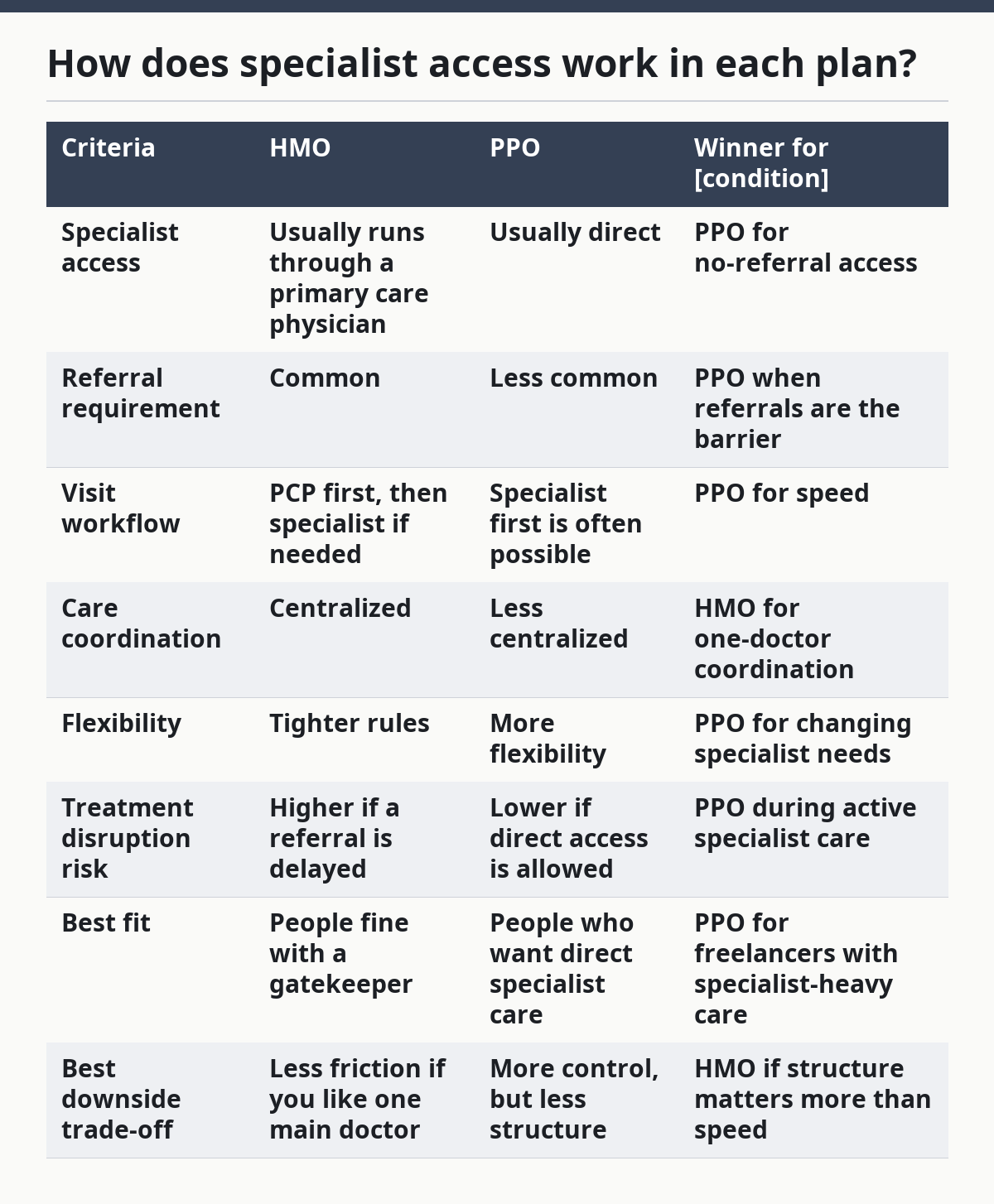
The weakness of a PPO is not mystery; it is trade-off. More freedom can mean less built-in coordination, so a freelancer has to stay organized about which specialist to see and when. The weakness of an HMO is the delay itself. If the referral does not happen quickly, the plan can turn a simple appointment into a multi-step process.
When does an HMO still make sense?
An HMO still makes sense when a freelancer can live with the referral step and wants a care system that runs through one primary care physician. That is the plan for someone who values structure more than direct access.
The real strength of an HMO is control. It can keep care routed through one main doctor, which helps when a person wants a single point of contact and fewer open-ended choices. If specialist visits are rare, that workflow may feel orderly instead of annoying.
The drawback is obvious: the plan can slow down specialty care. A freelancer who needs dermatology for an ongoing skin issue, orthopedics after an injury, or cardiology for follow-up visits may find the referral gate more than a mild inconvenience. Every extra step adds time, and time matters when work and health both need attention.
Certain state restrictions on HMOs were removed if the HMO was federally certified, according to Wikipedia. That history matters because it shows why HMOs became more standardized over time, but it does not change the basic user experience today: PCP first, specialist later if a referral is needed.
An HMO is not the right pick for a freelancer who wants to self-direct specialist care. It is also not the right pick for someone who gets irritated by being told to start with a primary care physician for nearly every specialist issue.
When is a PPO the better fit?
A PPO is the better fit when a freelancer wants to see specialists with as little referral friction as possible. If the main complaint is “I do not want to ask permission before I book the doctor I actually need,” PPO is the stronger choice.
That freedom matters most in specialist-heavy care. Dermatology, orthopedics, cardiology, and other focused fields often come with follow-up visits, and a plan that does not lean on referrals can save a lot of back-and-forth. For a freelancer, that means fewer delays and less time spent trying to fit a PCP visit into an already packed week.
The drawback is that flexibility is not free. A PPO can be less structured, which means the plan expects the member to make more decisions. Someone who likes having one main doctor manage every step may find that less comfortable. There is also a practical risk: more freedom can make it easier to book care without enough coordination.
Here is the honest short list.
Pros of a PPO:
- Better fit for direct specialist access
- Less dependence on a referral
- Easier to move fast when a specialist issue comes up
Cons of a PPO:
- Less built-in coordination
- Can feel less guided than an HMO
- Not ideal for someone who wants one doctor to direct most care
A PPO is the wrong choice for a freelancer who likes simple, centralized care and does not mind starting with a PCP. It is also the wrong choice if the only reason for choosing it is habit, not specialist access.
The honest side-by-side
The difference shows up fastest in the steps between needing care and getting care. For a freelancer, that gap is the whole story.
| Criteria | HMO | PPO | Winner for [condition] |
|---|---|---|---|
| First stop | Primary care physician | Often the specialist directly | PPO when speed matters |
| Referral barrier | Commonly part of the workflow | Usually lighter | PPO for fewer steps |
| Specialist-heavy care | More paperwork and routing | More direct access | PPO for ongoing specialist needs |
| Coordination | Stronger central control | More self-management | HMO for one-doctor oversight |
| Treatment continuity during a switch | Medicare.gov says at least 90 days before new prior approval for ongoing treatment | Same rule applies when coverage changes | Tie for plan changes |
| State and federal plan history | HMO rules changed as federally certified plans grew; according to Wikipedia, 1977 marked rapid growth | Not the same managed-care structure | HMO for people who want a more managed system |
| Fit for freelancers | Better only if specialist access is not urgent | Better when specialist access is the priority | PPO for this topic |
| Main risk | Delays before the specialist visit | Less central coordination | Depends on how much structure you want |
For this reader, the winner is clear. The HMO can be sensible, but it solves a different problem. The PPO is the one that directly answers the question: how do I get to the specialist without a referral getting in the way?
What should a freelancer choose?
Choose PPO if you want to book specialists without a referral gate and you are willing to handle a little less structure. Choose HMO if you are comfortable starting with a primary care physician and the referral step does not bother you. Neither if you know you need frequent specialist visits but are not ready to check the plan’s access rules closely.
That is the clean decision line. A freelancer who needs dermatology, orthopedics, cardiology, or similar care without extra steps should favor the PPO because the workflow matches the need. An HMO can still be a smart choice for someone who wants one main doctor and does not mind routing specialist care through that office.
The biggest mistake is choosing an HMO and hoping referrals will never slow anything down. That is not a plan for direct specialist access. The second mistake is choosing a PPO only because it sounds more flexible, then finding out you wanted a more managed system after the fact.
If the question is specialist access without referrals, the answer stays the same: PPO first.
What if the choice flips?
The verdict flips if the specialist is not the real problem. If the main priority is a single doctor coordinating routine care, an HMO can be the better fit even with referral rules.
It also flips if a freelancer is changing plans mid-treatment. Medicare.gov says the new plan must give at least 90 days before asking for new prior approval for ongoing treatment, so the immediate switch may matter less than the current treatment chain. In that case, the plan already in force can matter more than the label on the next card.
A third flip happens when a freelancer rarely sees specialists. If the specialist need is occasional rather than central, the referral barrier may not justify paying for more flexibility. A structured HMO can then be enough.
A fourth flip happens when the freelancer values simplicity over speed. Some people would rather use one primary care physician and let that doctor route the rest of the care. For them, the HMO’s managed setup is not a flaw; it is the point.
How do referrals work for specialist care?
A referral is the step that moves you from a primary care physician to a specialist, and in an HMO it is often the key that opens the specialist visit. The referral is the part that can slow things down, because it adds one more appointment or approval before the specialist sees you.
That is why referrals matter so much for freelancers. Time off is not always simple, and rebooking around a PCP visit can be harder than rebooking around the specialist itself. If the plan requires the referral, the process usually starts with the primary care physician rather than the specialist’s office.
The most important thing is to treat the referral as part of the plan design, not a small detail. For specialist care, it changes the workflow, the timing, and sometimes the whole choice of plan. That is exactly why PPOs are usually the better match when referral-free specialist access is the goal.
Do all HMOs require referrals?
No, not every HMO works the same way, but referrals are common enough that you should assume they may be part of the process. That is the safe assumption when specialist access without delay matters. If you are a freelancer who needs direct access, the referral question should be checked before you enroll.
Can a PPO still require referrals?
Yes, a PPO can still require referrals in some cases. The label does not remove every rule, so the plan details still matter. The reason PPOs are usually preferred here is that they are generally less dependent on a referral than HMOs.
How do referrals work for specialist care?
A referral usually starts with the primary care physician, who points you to the specialist and sets the care path. That adds a step before the specialist visit and can delay care if the PCP appointment is not quick. For a freelancer who needs specialist access without that barrier, that workflow is the main reason PPOs tend to win.
Sources
- Wikipedia, Health maintenance organization – Wikipedia (checked 29 Nov 2026)
- Medicare.gov, Health Maintenance Organizations (HMOs) – Medicare (checked 29 Nov 2026)
Drafted with AI; not yet reviewed by a person.