
Last updated: November 19, 2026
Key Takeaways
- ACA subsidies use modified adjusted gross income, not gross freelancing receipts.
- Freelancers should estimate full-year income, subtract allowed business costs, and factor in MAGI adjustments.
- Update the Marketplace promptly if your annual income estimate shifts enough to change your premium tax credit.
- Form 8962 reconciles the advance credit with the income you actually earned.
If your income changes during the year, a practical way to keep ACA subsidies accurate is to estimate your modified adjusted gross income (MAGI) as closely as you can, update the Marketplace when that estimate changes, and reconcile everything on Form 8962 at tax time. In this guide to How freelancers report income for ACA coverage and avoid subsidy surprises, the goal is to get the estimate close enough to reduce a repayment or an undersized premium tax credit.
Freelancers get tripped up because ACA coverage is based on expected yearly income, not what came in last month. A slow quarter, a late client payment, or a deductible expense can change the size of your premium tax credit. The trick is to treat subsidy income like a moving target and keep a running estimate, and if your situation is complicated, consult a tax professional or Marketplace navigator. For a broader overview of plan shopping and enrollment, the hub on ACA marketplace health insurance for freelancers belongs beside this guide.
What ACA uses: your modified adjusted gross income

ACA subsidies are based on modified adjusted gross income, not your gross receipts from freelancing. MAGI starts with the tax version of your income and then adds back some items that were excluded or adjusted elsewhere. For freelancers reporting income for ACA coverage, the practical question is simple: what number will end up on the income line that drives your marketplace subsidy calculation?
For self-employed people, the biggest moving parts are usually:
- Self-employment income from clients, side projects, or contract work
- Business deductions that reduce taxable profit
- Other household income, such as a spouse’s wages, interest, unemployment compensation, or retirement income
This matters because a freelancer can have $60,000 in client payments and a much lower MAGI after business deductions, retirement contributions, and other tax adjustments. The Marketplace does not care about cash in the bank. It cares about the tax household’s projected annual number.
A common mistake is to estimate subsidy income from deposits alone. That usually overshoots if the business has real expenses, or undershoots if the freelancer forgets about other income that counts in the household total. A second mistake is to use last year’s return without adjusting for this year’s actual workload. A quieter year, one big client drop, or a new spouse’s job can make last year’s figure useless.
The right standard is the year you are in, not the year you wish you were in. If a freelancer has irregular income, the estimate should be rebuilt as the year changes. That is the part most people skip.
How do freelancers estimate income for ACA?
Freelancers estimate income for ACA by projecting the full year, starting with expected client revenue and then subtracting business expenses and the tax adjustments that affect MAGI. The estimate does not need to be perfect, but it should be believable enough that you can defend it if the year changes.
Use this process:
- List every income source for the household for the year, not just freelance work. Include W-2 wages, client payments, spouse income, interest, and any taxable retirement income. The result is a household-wide starting point, which is the number the Marketplace actually needs.
- Estimate gross freelance receipts for the remaining months, then trim out expected business expenses. Use categories that match your tax records: software, supplies, subcontractors, insurance tied to the business, office costs, and mileage if you track it. The result should be closer to net profit than to raw deposits.
- Adjust for items that change MAGI, such as pre-tax retirement contributions if you are making them, student loan interest deductions, or other tax adjustments that affect the return. This step keeps the estimate closer to the line that matters for subsidies.
- Break the year into months or quarters if your income is uneven. A freelancer who earns most money in the fall should not average the year blindly if the first half is thin. The result is a forecast that matches cash flow instead of smoothing it away.
- Keep the estimate in a simple worksheet and compare it to actual year-to-date income every month or every quarter. If the gap becomes meaningful, update the Marketplace rather than waiting for tax season.
A practical way to think about it: if you know a major client ended in March, that is a real input, not noise. If you land a three-month retainer in July, that changes the annual number. The estimate should move when the business moves.
The biggest trade-off here is precision versus speed. A detailed forecast takes time, but a rough guess can cost money later. A freelancer with steady monthly retainer work can use a clean annual estimate. Someone with project spikes and dry spells should use a month-by-month view.
Which deductions matter, and which do not?

The deductions that matter are the ones that change your tax return and, by extension, your MAGI; the ones that do not affect your return usually do not affect your ACA subsidy. That is the difference between a deduction you track for tax filing and a figure you can use to lower your subsidy income estimate.
For most freelancers, the meaningful items are business deductions that reduce self-employment profit before tax:
- Ordinary and necessary business expenses
- Home office deductions, if you qualify
- Retirement contributions that are deductible for tax purposes
- The self-employment tax deduction that appears on the tax return
The mistake is to subtract personal spending that the IRS does not treat as a business deduction. A new laptop for work may count if it is a business asset; groceries, rent for your apartment, and personal travel generally do not. ACA math does not reward wishful accounting.
Another common trap is assuming a deduction lowers subsidy income automatically in the same way it lowers taxable income. The Marketplace estimate is based on projected MAGI, so the deduction only helps if it truly changes that number. A freelancer who says “I spent money on the business, so my income is lower” still has to show the expense in a tax-valid category.
This is also where self-employment income needs careful handling. If you file Schedule C, the profit after business expenses is the starting point. If you are an independent contractor with multiple 1099-NEC forms, add them together, then subtract the related expenses. If you have side income from a course, digital product, or consulting package, it still belongs in the forecast if it is taxable business income.
The honest limitation: tax rules can be technical, and the details matter more than the category name. A freelancer with a high-dollar home office claim, a retirement contribution strategy, or a mixed W-2 and Schedule C household should speak with a tax professional before relying on a subsidy estimate built from memory.
When should you update the Marketplace during the year?
You should update the Marketplace as soon as your annual income estimate changes in a way that is likely to affect your premium tax credit. Waiting until the end of the year is how subsidy surprises happen.
The biggest triggers are easy to spot:
- A contract ends and your expected annual freelance income drops
- You land a major new retainer or second stream of work
- Your spouse changes jobs, loses work, or starts earning more
- You marry, divorce, add a dependent, or otherwise change the tax household
- Your year-to-date income starts running far above or far below the forecast
A practical rule is to check after any change that will last more than 1 or 2 months. A single slow week usually does not justify a reset. A lost client that removes 20% of expected annual revenue probably does.
The cost of not updating is straightforward: if your subsidy is based on income that is too low, you may have to pay some of it back on Form 8962. If the estimate is too high, you may get less help than you were entitled to during the year. Either way, the correction lands on your tax return, not in the month the mistake happened.
Keep the update focused on the annual total, not the month-by-month mood of your bank account. Freelancers often panic after one weak month and slash the estimate too hard. That can create the opposite problem. A better move is to recalculate the full year using actual year-to-date numbers plus the most likely remaining months.
If the year becomes wildly uncertain, use scenarios: a base case, a conservative case, and a strong-case income estimate. Then choose the one that best matches your current workload and update it again if the business changes.
What happens on Form 8962 at tax time?
Form 8962 is where your final premium tax credit gets reconciled against the income you actually earned. If your projected income matched reality, the form is mostly a confirmation. If it did not, the form is where the correction shows up.
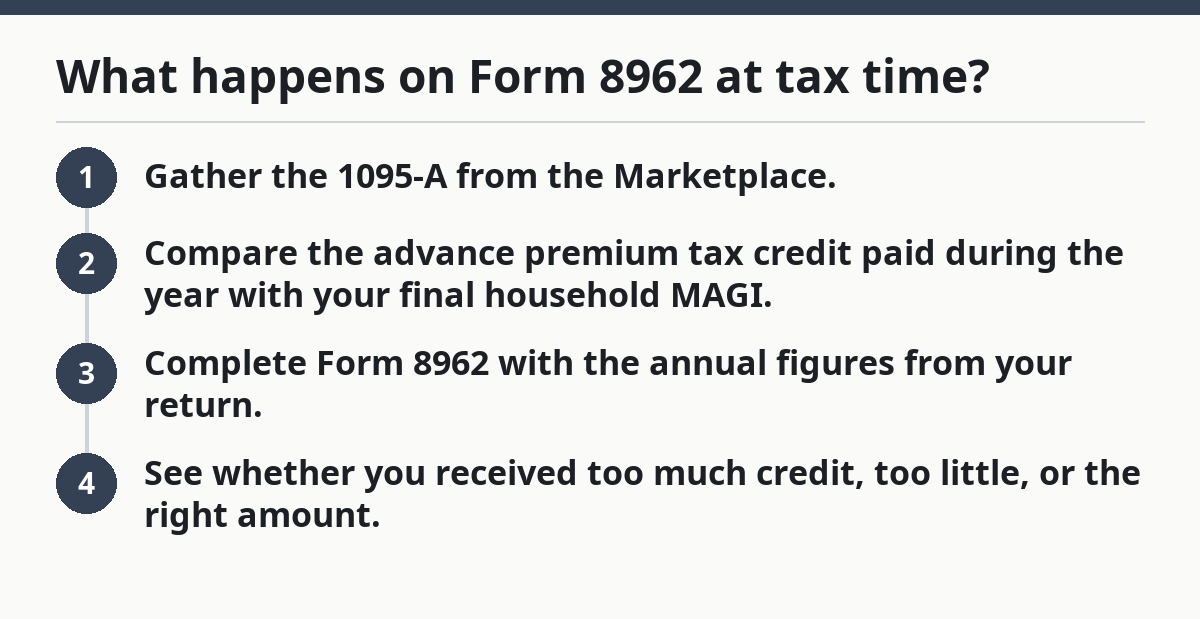
At tax time, the process is usually:
- Gather the 1095-A from the Marketplace.
- Compare the advance premium tax credit paid during the year with your final household MAGI.
- Complete Form 8962 with the annual figures from your return.
- See whether you received too much credit, too little, or the right amount.
The 1095-A is not optional here. It is the record of the coverage and the subsidy advanced during the year, and Form 8962 uses it to do the math. If your income went up and you did not update the Marketplace, the reconciliation may reduce your refund or increase what you owe. If your income went down and you stayed eligible, the form may increase your credit.
A freelancer should not treat this as a surprise bill to be solved in April. It is the final checkpoint on the estimate you made all year. If the number on Form 8962 looks off, the fix usually starts with the income forecast, not the form itself.
One honest downside of ACA subsidies is that they force precision at tax time. Irregular income makes that harder. The system is fairer when you can forecast, but it is unforgiving when you guess. That is why the monthly or quarterly check-in matters as much as the final return.
For a broader overview of the coverage side, the hub on ACA marketplace health insurance for freelancers is the right next stop; this page is about the income math that keeps the subsidy from drifting.
How to avoid subsidy surprises without overthinking it
You avoid subsidy surprises by keeping a running income estimate, updating it when the year changes, and documenting the reason for each adjustment. That takes less time than fixing a bad estimate later.
Use a simple routine:
- Review actual year-to-date freelance income once a month or once a quarter
- Compare it to the full-year estimate
- Adjust for known changes in work, household income, or business deductions
- Save the worksheet, client list, and major expense notes in one place
- Revisit the estimate before filing if the year ends differently than expected
The best version of this system is boring. It is a spreadsheet, a calendar reminder, and a few honest assumptions. It is not a heroic year-end cleanup.
The mistake I would avoid is chasing tiny fluctuations. A freelancer does not need to update the Marketplace every time a payment arrives a week early. What matters is a real shift in the annual picture. If the estimate changes in a way that would materially affect the premium tax credit, update it. If not, keep working.
The second mistake is treating ACA income as a tax-season problem. It is a year-round problem with a tax-season cleanup. That distinction is what keeps the subsidy close to reality.
If the household has complicated income, multiple businesses, or uncertain deductions, a tax professional can help translate the forecast into a MAGI estimate before the numbers start drifting. That is especially worth it if you are close to a subsidy cutoff or if your income has swung sharply from one year to the next.
How do freelancers estimate income for ACA?
Freelancers estimate income for ACA by projecting household modified adjusted gross income for the full year, not just freelance deposits. Start with expected client revenue, subtract ordinary business expenses, then add other taxable household income such as wages or interest. Recheck the total monthly or quarterly so the estimate stays close to reality.
What if my income changes midyear?
Update the Marketplace when the change is large enough to alter your full-year income estimate. A lost client, a new retainer, or a spouse’s job change can shift your premium tax credit. If the change is small or temporary, you can usually wait and recalculate during your next review.
How do I reconcile my subsidy at tax time?
You reconcile it with Form 8962 and your Form 1095-A. The form compares the advance premium tax credit you received during the year with your final household MAGI. If the estimate was off, the difference shows up on your tax return as an adjustment to your refund or amount due.
Sources
- IRS: Form 8962, Premium Tax Credit
- HealthCare.gov: Premium tax credit
Drafted with AI; not yet reviewed by a person.