Last updated: November 20, 2026
Quick Answer: 1 clear annual estimate backed by current records is usually enough for ACA enrollment and subsidies.
Freelancers prove income for ACA enrollment and subsidies by estimating current-year self-employment income and backing it up with tax records, business records, and any proof that shows what they expect to make. This guide on how freelancers prove income for ACA enrollment and subsidies shows which documents help, how to line up the numbers, and what the marketplace is actually looking for.
Key takeaways
- Your application usually rests on a current-year estimate, not last year alone.
- A Schedule C and Form 1040 help when you have filed taxes; profit and loss records help when you haven’t.
- The marketplace wants a number that is believable, consistent, and explained.
- Irregular freelance income is not a problem by itself, but unsupported guesses are.
What the ACA application is asking for
The ACA application is asking for a reasonable picture of your yearly household income, not a perfect forecast. For a freelancer, that usually means the marketplace wants to know what you expect to earn from self-employment this calendar year, plus any other income that belongs on the application.
Picture this: you’re filling out a marketplace application on healthcare.gov or your state exchange, and it asks for income you have not fully earned yet. The form is built for estimates, so the job is to show how you got your number, not to pretend you know the future. That is the whole game.
Freelancers usually support the estimate with some mix of:
- Last year’s Form 1040
- Schedule C from a filed return
- Current profit and loss statement
- Invoices, contracts, or 1099s
- Bank records or bookkeeping reports
The market-facing term you may see is ACA application income verification, but the logic is simple: show the source of the money, show the pattern, and show the math. If you use only a guess, the number can look thin. If you use documents that point to the same annual total, the application is easier to defend.
A tax return alone does not always tell the whole story. Last year’s return is useful, but it may understate or overstate this year if your workload changed. The marketplace cares about the year you’re applying for. That is why current records matter.
Sources that are worth knowing include healthcare.gov and your state exchange site, because those are the places where the application rules and help text live. If a question on the form feels vague, the help text on the site usually points you back to estimated income for the year, not net profit from one random month.
Which documents actually prove freelance income?
Freelancers prove income with tax returns when they have them, and with business records when they do not. A clean file often includes a Form 1040, Schedule C, and a current profit and loss statement that matches the year-to-date numbers.
Picture this: you’ve been freelancing for 18 months, and your income swings from one month to the next. The marketplace does not need a polished story. It needs documents that show how you got to the figure you entered, and it helps if those documents line up with one another.
The strongest documents are usually:
- Form 1040: shows your tax return history
- Schedule C: shows gross receipts, expenses, and net profit from self-employment
- Profit and loss statement: shows current business income and costs for the year so far
- 1099-NEC or 1099-K: shows reported payment history from clients or platforms
- Client invoices and payment records: show that the work is real and recurring
- Bank statements: help support deposits tied to freelance work
A 1040 and Schedule C are backward-looking. A profit and loss statement is forward-facing enough for the application because it can reflect the current year. That matters when your 2024 tax return is already stale but your 2026 income is changing now. If the marketplace asks for proof, the combination matters more than any single sheet.
A common mistake is handing over tax forms without context. That can cost time if the numbers on the return don’t fit the current application year. The better move is to attach or keep ready a short income summary that explains the shift. Example: “Last year’s gross receipts were lower because two clients ended in March; current retainer work now makes the annual estimate higher.” Short. Plain. Useful.
On the flip side, a pile of receipts alone is weak. Receipts prove spending, not income. The marketplace wants income support, so keep the documents that show money coming in.
How do freelancers estimate annual income for the marketplace?
Freelancers estimate annual income for the marketplace by totaling expected self-employment profit for the rest of the year and adding any other income that belongs on the application. The goal is a believable annual figure, not a perfect forecast.
Picture this: it’s February, your book of work is half client gigs and half quiet weeks, and you need an annual number that won’t collapse under scrutiny. Start with the income you already have, then add the work you can reasonably expect to finish before December 31. That number should fit the documents you can show.
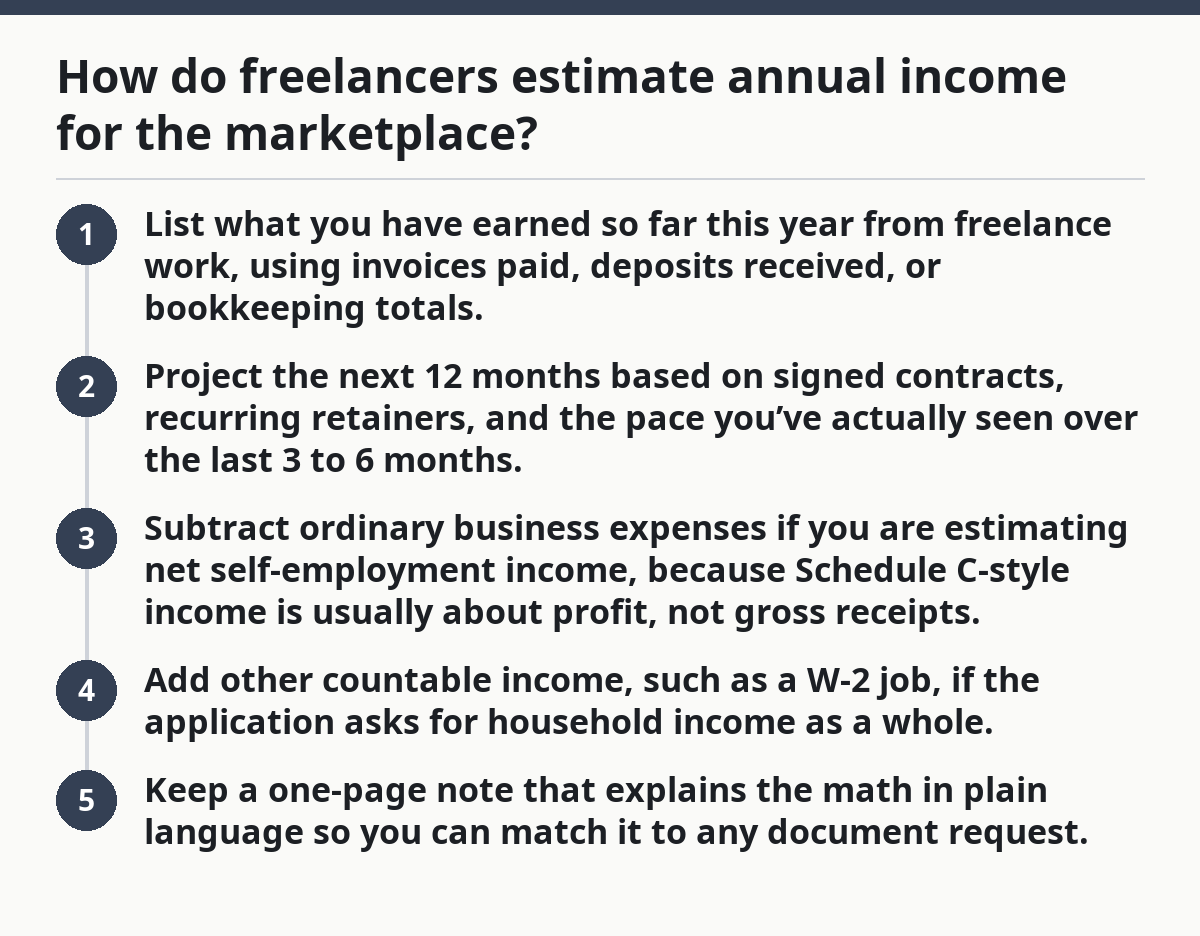
Use this simple process:
- List what you have earned so far this year from freelance work, using invoices paid, deposits received, or bookkeeping totals.
- Project the next 12 months based on signed contracts, recurring retainers, and the pace you’ve actually seen over the last 3 to 6 months.
- Subtract ordinary business expenses if you are estimating net self-employment income, because Schedule C-style income is usually about profit, not gross receipts.
- Add other countable income, such as a W-2 job, if the application asks for household income as a whole.
- Keep a one-page note that explains the math in plain language so you can match it to any document request.
A boring estimate is often the best estimate. It is built from a monthly average, a signed contract, or a repeat client pattern. If you earned $4,000 a month for the last 4 months and your workload is steady, the application number should reflect that pattern rather than a wishful high-water mark. If your work is seasonal, say so in the notes.
A weak estimate is one that jumps around without a reason. If your application says one thing and your bank deposits say another, the marketplace may ask for more proof. That does not mean you are out of options. It means you need cleaner math.
A useful habit is to keep a running profit and loss record every month. Even a simple spreadsheet with date, client, amount, and expense category can make the annual estimate easy to defend. It also makes next year’s tax return less painful. Big difference.
What if your income changes month to month?
Irregular freelance income is fine if your estimate reflects the pattern and you keep records that explain the swings. The problem is not variability; the problem is a number that has no paper behind it.
Picture this: one month you land a $7,500 project, and the next month you scrape by on two small invoices. That is normal freelance life. The marketplace does not require a smooth salary. It wants a yearly number you can defend with actual business records and a clear explanation of why the monthly pace changes.
What helps most:
- A 6- or 12-month profit and loss statement
- A list of recurring clients or retainers
- Recent invoices that show your current rate
- Bank deposits that match those invoices
- A note about seasonality, project cycles, or gaps between contracts
This is where proof of projected income matters. If a contract is signed for the next 3 months, that contract is more useful than a vague hope for more work. If your income is tied to a launch cycle, a holiday rush, or a summer slowdown, say that in the notes. Specific beats emotional.
What does not help is smoothing your income too hard. If you earned nothing for 2 months and then one big check in the third month, averaging it into a neat salary without explanation can make the number look fake. Better to present the pattern honestly and show why the year still lands where it does.
If you have just started freelancing, lean on current contracts, expected billings, and any repeat work already booked. If you’ve freelanced for years, last year’s Schedule C and current year-to-date records can support a more stable estimate. The documents should tell the same story, even if the story includes swings.
How do you upload or explain the proof to the marketplace?
You upload the cleanest documents you have and explain the income math in plain language when the marketplace asks for clarification. The file does not need to be fancy; it needs to be readable, current, and consistent.
Picture this: you get a request after submitting your ACA application, and the upload box asks for proof of income. This is where many people overcomplicate things. A clear PDF set is better than five half-legible photos and a long explanation nobody can follow.
A practical file usually includes:
- One recent profit and loss statement
- The latest filed Schedule C if you have one
- A current Form 1040 if requested
- Recent invoices or 1099s
- A brief note with the annual estimate and the method used
Keep the note short. Example: “Estimated annual self-employment income is based on current year-to-date receipts, three active monthly retainers, and expected project work through December.” That tells the reviewer how the number was built without drowning them in detail.
If the marketplace asks for proof through healthcare.gov or your state exchange, follow the upload format they give you. Some systems want one PDF per document; others accept multiple files. If the system has a deadline, meet it. A missing file can slow the decision even when your income estimate is reasonable.
You do not need to prove every dollar with a receipt. You need a convincing record set. For freelancers, that usually means tax forms plus current business records. If a document is missing, use the next best paper that points to the same annual total.
What mistakes cause problems?
The biggest mistakes are using old tax numbers as if they were current, guessing high without support, and sending documents that don’t match the application. Those errors can trigger follow-up questions or a request to fix the file.
Picture this: you enter last year’s net profit because it was easy, but this year you have two new retainers and a side contract. The estimate may be too low or too high, and either direction can create trouble. The issue is not just accuracy; it is whether the number fits your current life.
Common mistakes and what they cost:
- Using only last year’s return: can miss a big current change
- Using gross income instead of net when the form expects profit: can overstate earnings
- Ignoring expenses: can inflate the estimate
- Uploading unreadable screenshots: slows review
- Giving different numbers on different forms: creates a mismatch that invites more questions
The fix is plain. Match the estimate to the same method each time. If you use net self-employment income, calculate it the same way on the application note, the profit and loss statement, and the Schedule C-style records. If you are unsure whether a countable item belongs in your estimate, check the marketplace instructions or ask a tax professional before you submit.
This page supports the larger rules in the hub on Self-Employed Health Insurance Eligibility and Enrollment Rules — The Complete Guide. That hub covers the bigger picture. This page is narrower: the papers and the math.
What records should you keep after you apply?
You should keep the application, the proof you submitted, and the math behind your estimate for at least the full coverage year, and longer if your records are part of your tax files. That way, if the marketplace asks later, you are not rebuilding the paper trail from scratch.
Picture this: six months after enrollment, you need to remember why you said your income would be $X for the year. If you kept a tidy file, the answer is already there. If you did not, you may be staring at old bank statements and guessing at your own timeline.
A good file has:
- The submitted ACA application pages
- The income estimate worksheet or note
- Filed tax returns, when available
- Current year invoices and profit and loss records
- Any marketplace letters asking for more proof
Keep the records in one folder, digital or paper. A single PDF packet works well because it keeps the 1040, Schedule C, and support docs together. If you update your estimate during the year, save the old version too. The change itself may matter later.
A freelancer who keeps monthly records usually has an easier time not just with the ACA application, but with taxes, client planning, and next year’s estimate. That is not a sales pitch. It is just what clean books do.
What documents can freelancers use to prove income?
Freelancers can use tax returns, Schedule C forms, profit and loss statements, invoices, 1099s, and bank records to prove income. The strongest file usually combines an old tax return with current-year business records, because one shows history and the other shows what is happening now.
How do freelancers estimate annual income for the marketplace?
Freelancers estimate annual income by projecting what they expect to earn during the calendar year and backing it with current records. A monthly average, signed contracts, and year-to-date profit and loss records are usually more persuasive than a rough guess. The number should fit the documents you can show if asked.
What if freelance income is irregular?
Irregular freelance income is still acceptable if the estimate matches your real pattern and your records explain the swings. Seasonal work, project-based income, and uneven client flow are common. What matters is showing why the annual number makes sense, not pretending every month looks the same.
Drafted with AI; not yet reviewed by a person.