Last updated: November 20, 2026
Quick Answer: 3 options matter most. Freelancers comparing dental, vision, and add-on benefits need to decide what belongs in the same purchase and what should stay separate. How freelancers compare dental, vision, and add-on benefits before buying coverage comes down to comparing the health plan, the rider, and any standalone policy as one monthly package before you buy. The sections below settle which benefit fits which kind of freelancer and what usually gets missed.
Key Takeaways
- Freelancers usually choose between included and optional benefits, not just “dental” versus “vision.”
- Standalone dental can suit routine care when you want dental kept separate from medical coverage.
- Vision coverage can fit a yearly eye exam and help with glasses or contacts.
- Included benefits can be simplest, while standalone coverage can offer more control.
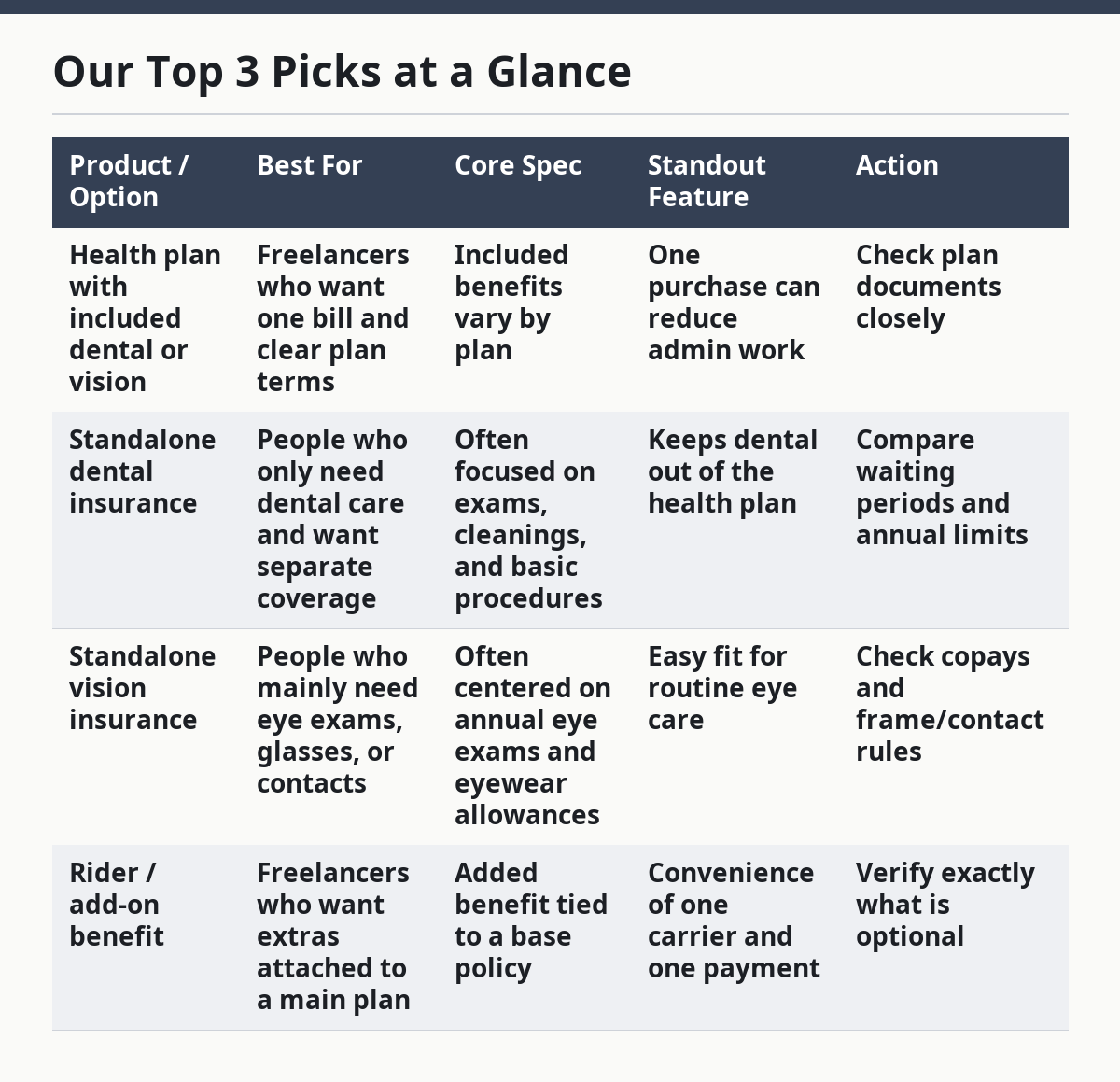
Our Top 3 Picks at a Glance
- #1 Best Overall: A health plan with included dental or vision only when the extras are clearly spelled out in the plan documents.
- #2 Best Budget Pick: A standalone dental or vision policy when you only need exams, cleanings, glasses, or contacts.
- #3 Best Heavy-Duty / Upgrade Pick: A rider or add-on when you want a simple checkout and are okay paying one premium for bundled coverage.
| Product / Option | Best For | Core Spec | Standout Feature | Action |
|---|---|---|---|---|
| Health plan with included dental or vision | Freelancers who want one bill and clear plan terms | Included benefits vary by plan | One purchase can reduce admin work | Check plan documents closely |
| Standalone dental insurance | People who only need dental care and want separate coverage | Often focused on exams, cleanings, and basic procedures | Keeps dental out of the health plan | Compare waiting periods and annual limits |
| Standalone vision insurance | People who mainly need eye exams, glasses, or contacts | Often centered on annual eye exams and eyewear allowances | Easy fit for routine eye care | Check copays and frame/contact rules |
| Rider / add-on benefit | Freelancers who want extras attached to a main plan | Added benefit tied to a base policy | Convenience of one carrier and one payment | Verify exactly what is optional |
What freelancers are really comparing when they buy dental and vision coverage
Freelancers are usually choosing between included vs optional benefits, not just “dental” versus “vision.” The real comparison is whether the benefit is built into the health plan, added as a rider, or bought as a standalone policy.
Picture this: you’re signing up for coverage after a client contract starts, and the page offers dental, vision, and a few add-ons in the same cart. The smart move is to ask what each line actually covers, because “included” can mean very little or a lot. A bundled checkout feels tidy. It can still be a bad fit.
Here’s the catch: the same label can hide very different rules. A dental policy may cover exams and cleanings but make you wait for more serious work; a vision policy may cover an eye exam but push most of the cost of glasses and contacts back on you.
Use this checklist before you buy:
- Is the benefit part of the health plan, or does it sit beside it?
- Is it a rider that depends on the base policy?
- Is it a standalone policy with its own premium and rules?
- Does the plan mention copays, deductibles, waiting periods, or annual limits?
- Does the coverage fit your real use: routine care or one big expense?
The plan document is often the most reliable source for this stage, not the sales page. For a neutral starting point on health coverage terms, the U.S. Department of Labor’s consumer materials on benefits and coverage are useful, and the National Association of Insurance Commissioners also publishes plain-language insurance guides. The Centers for Medicare & Medicaid Services also explains plan documents and coverage basics.
Why standalone dental often wins for freelancers
Standalone dental wins when you want predictable routine care and don’t want dental tied to the rest of your health coverage. It can be the cleaner choice for freelancers who mainly need cleanings, exams, and basic treatment rather than a large medical package; if you are unsure, consult a professional and compare plan documents.
Picture this: you go months without seeing a dentist, then remember you still need a cleaning and maybe a filling. A standalone dental policy can make that easier to budget for, especially if the dental benefit in a health plan is weak or absent. It also keeps dental decisions separate from your medical network.
The truth is, standalone dental is not a magic bargain. Many plans have waiting periods, annual maximums, or tighter coverage on crowns, bridges, and orthodontics. That means the policy can look good on paper and still leave you paying out of pocket when the work gets real.
Use standalone dental if this sounds like you:
- You mainly want routine dental care.
- You can wait for benefits to kick in.
- You care more about basic services than major restorative work.
- You prefer a separate decision instead of bundling dental into the health plan.
Don’t buy it just because the checkout page makes it easy. A standalone policy can be weaker if you need major work soon, if the network is thin in your area, or if the annual cap is too low for the treatment you already know is coming; consult a professional and review the source plan documents. That’s where the fine print matters more than the label.
Why vision insurance or a vision rider can be the smarter buy
Vision coverage wins when your main need is a yearly eye exam and help with glasses or contacts. For many freelancers, that makes it a simple add-on rather than a full separate priority.
Picture this: you already have a medical plan you like, but your eyes keep costing you the same few things every year—an exam, a frame purchase, maybe contact lenses. A vision rider or standalone vision policy can make those repeat expenses more manageable without changing the rest of your coverage.
The catch is that vision is often a narrow benefit. It may cover the exam and give you an allowance for eyewear, but it usually will not help much beyond that. If you need specialist care, surgery, or broader eye-health treatment, the medical side of the health plan still matters more than the vision add-on; if that applies to you, consult a professional and check your plan documents.
Vision insurance or a vision rider tends to fit:
- Freelancers who wear glasses or contacts every year.
- People who want routine eye exams on a fixed schedule.
- Buyers who value convenience over broad coverage.
- People whose main goal is lowering the cost of eyewear, not medical eye care.
Skip vision coverage if you rarely need eye care and buy glasses only occasionally. In that case, paying separately for an exam or eyewear may cost less than carrying a policy you barely use. A rider can also be a poor fit if it only works with a base plan that already has higher monthly cost than you want.
The honest side-by-side: standalone policy, rider, or included benefit
The included benefit usually wins for simplicity, but the standalone policy often wins for control. A rider sits in the middle: easy to buy, but only worth it if the added rules still fit your needs.
Picture this: you have three tabs open and each one looks “affordable.” What changes the answer is not the monthly number alone, but what you lose in flexibility, what you gain in convenience, and whether the benefit matches the kind of care you actually use.
| Criteria | Included benefit in health plan | Standalone dental or vision policy | Winner for this condition |
|---|---|---|---|
| One bill | Yes | No | Included benefit |
| Separate decision for only one need | No | Yes | Standalone policy |
| Easy to compare at signup | Sometimes | Yes | Standalone policy |
| Strong fit for routine care | Sometimes | Often | Standalone policy |
| Strong fit for one bundled purchase | Yes | No | Included benefit |
| Less plan juggling | Yes | No | Included benefit |
| More room to shop carriers | No | Yes | Standalone policy |
| Better when benefits are thin | No | Yes | Standalone policy |
| Best when the add-on is optional and clear | Yes | Sometimes | Included benefit |
The real trap is assuming “extra coverage” means “better coverage.” It does not. A thin vision rider and a weak dental add-on can still cost more over time than paying out of pocket for a few services.
Use the table this way:
- Pick included benefits when you want one purchase and the benefits are clearly described.
- Pick a standalone policy when the extra coverage matters, but the health plan’s version looks weak.
- Pick a rider when the base plan is already the one you want and the add-on is cheap, clear, and easy to use.
When should a freelancer choose add-ons instead of separate plans?
A freelancer should choose add-ons instead of separate plans when the extra coverage is simple, routine, and attached to a health plan that already fits. That is the cleanest answer when you want fewer moving parts.
Picture this: you are already comparing deductibles, networks, and whether the health plan works in your city. The last thing you want is another carrier, another login, and another policy to track. An add-on can reduce friction if the bundled terms are honest and the coverage is actually usable.
On the flip side, add-ons lose when the attachment becomes a trap. If the rider only works with a base plan you dislike, the convenience is fake. If the add-on is expensive relative to what it pays for, you are buying paperwork, not protection.
Add-ons make sense when:
- The benefit is routine and predictable.
- You want to keep everything under one carrier.
- The health plan is already your best fit.
- The rider terms are plain and short.
Add-ons are a bad move when:
- The base health plan is mediocre.
- The rider hides limits, waiting periods, or narrow service rules.
- You need more control over dental or vision than the bundled option gives you.
- The coverage is so narrow that paying out of pocket is simpler.
This is where many freelancers get misled by convenience. Easy enrollment is not the same thing as good coverage.
The exceptions: when the usual answer flips
The usual answer flips when your current care pattern is unusual, your timing is tight, or your base health plan is unusually strong. In those cases, the “best” setup changes fast.
Picture this: you are not a standard case. You already know you need care soon, you have a preferred dentist, or your vision needs are more regular than average. That is when a simple rule like “buy the add-on” stops working.
The verdict can flip in these cases:
- You need dental work soon. A standalone policy with waiting periods may be the wrong buy if treatment is imminent.
- Your health plan already includes strong dental or vision terms. In that case, a separate policy can duplicate what you already have.
- You only need one service once in a while. Paying cash can beat carrying a policy for rare use.
- You hate admin more than you hate premiums. Then a rider or included benefit can beat shopping two separate policies.
That is also why plan documents matter so much. A rider that looks minor can still change the value of the entire purchase. If you are not sure what is already included, check before you add anything.
The verdict: which one should freelancers buy?
Choose standalone dental insurance if you want separate control over routine dental care and do not want that choice tied to your medical coverage. Choose a vision rider or standalone vision policy if your main need is exams and eyewear, and the add-on terms are plain. Neither if the extra benefit is thin, the waiting periods are long, or the health plan already covers enough for your real use.
Picture this: you want one simple rule to follow before checkout. Use this one—buy the add-on only when it solves a specific, repeat expense you already expect. If it does not change your day-to-day costs, skip it and keep the money for care you will actually use.
For the broader framework behind coverage fit, the hub on plan selection and coverage fit is the right next stop. This page answers the add-on question; that hub helps you place it in the larger buying decision.
Are dental and vision usually included in health plans?
Not always, and when they are included, the benefits can be limited. Some health plans bundle dental or vision, but many do not cover routine services like cleanings, eye exams, glasses, or contacts in a useful way. According to the National Association of Insurance Commissioners and the U.S. Department of Labor, plan terms matter more than the label.
Should a freelancer buy add-ons or separate plans?
Buy add-ons only if they fit neatly into a health plan you already want. Separate plans make more sense when you want to compare dental and vision on their own, or when the bundled option is too limited. For help comparing plans, review the plan documents and consumer guidance from the Centers for Medicare & Medicaid Services.
What do dental and vision benefits usually cover?
Dental benefits usually focus on exams, cleanings, and some basic treatment, while vision benefits usually focus on eye exams and help with glasses or contacts. The exact coverage depends on the policy, so the plan document matters more than the label.
Drafted with AI; not yet reviewed by a person.