
How freelancers find an in-network doctor after joining a health plan

Last updated: November 21, 2026
Quick answer: use a 2-step check for how freelancers find an in-network doctor after joining a health plan—search the provider directory first, then call the office to confirm the doctor still takes your health plan and is accepting new patients. That two-step check matters because a directory can lag behind real-world changes, and a doctor listed today may not be taking your exact plan tomorrow.
For freelancers learning how freelancers find an in-network doctor after joining a health plan, the directory is usually the quickest place to begin, but it is not the final check. This guide shows a 2-step process that can save time and reduce billing surprises.

Key takeaways
- The provider directory is a good place to start, but it is not the final word.
- A doctor can be “in network” and still not be taking new patients.
- Primary care doctors are the easiest first choice for most freelancers who need regular care.
- Specialists often have extra booking rules, referral steps, or longer waits.
- A quick phone call can save you from a surprise bill or a wasted appointment.
What is the fastest way to start?
A quick way to start is to use your health plan’s provider directory and search by plan name, doctor type, and zip code. If you want a primary care doctor, start there first; if you need a specialist, search for that specialty from the beginning so you do not waste time on the wrong list.
A directory is the plan’s list of doctors, clinics, and facilities that are supposed to be in its health plan network. That list is the right first stop after enrollment, but it is not enough on its own. The public guidance on provider directories from HealthCare.gov and plan directory standards from the Centers for Medicare & Medicaid Services both point to the same basic idea: directory data can change, so the plan and the office both matter.
Freelancers often need this step to be quick because they do not have an employer benefits team to call. The good news is that the search usually takes only a few minutes if you already know your plan name and the kind of care you need. The bad news is that skipping the verification call can leave you with a doctor who is listed but not actually available to you.
How do I use the provider directory?
You use the provider directory by matching your exact plan, then filtering for doctor type, location, and availability. That order matters because a doctor can accept one version of a carrier’s plan and not another, even inside the same health plan network.
- Log in to your health plan account or open the plan’s provider directory page. Use the name on your card, not a shorthand guess, because small plan labels can change which doctors show up.
- Enter your zip code and the doctor type you want. Choose primary care doctor if you need a general doctor, or choose a specialty like dermatology or cardiology if that is the care you need.
- Check the plan name shown on the result. Look for the same plan name you enrolled in, not just the same insurance company.
- Open the doctor’s profile and look for accepting new patients. If that line is missing, assume you still need to call.
- Write down the office phone number and the exact network name. That gives you a clean reference when you call the office or ask a customer service rep.
The main mistake here is treating the directory like a final guarantee. A directory is a map, not a promise. According to HealthCare.gov, provider directories can change, so it is wise to confirm details with the office or your plan before you book.
If the search result looks thin, search again with a nearby city or a broader specialty. Some directories sort by distance, so a doctor 8 miles away may show before one 2 miles away if the closer one is not taking new patients. That is annoying, but it is normal.
How do I know a doctor is actually taking my plan?
You know a doctor is actually taking your plan when both the directory and the office say the same thing. The directory can point you to a doctor, but the office staff can tell you whether that doctor is still in the health plan network and whether the practice is open to new patients.
The office call is the part many freelancers skip, and that is where problems start. A doctor may be listed as in network but not accepting new patients, not taking your specific plan tier, or only seeing patients at one office location. If the office says yes, ask them to repeat the plan name exactly as it appears on your card.
A useful rule is to verify three things in one call: network status, patient status, and appointment availability. If any one of those is a no, the practical answer is no for now. A listing that sounds close is not enough when your care and billing depend on exact match rules.
If you want a second check, use the customer service number on your plan card and ask them to confirm the doctor’s network status. That gives you another layer of confirmation without relying on a single source. For a general overview of plan networks and provider terms, the National Association of Insurance Commissioners is a solid standards resource to know by name.
Should I choose a primary care doctor first?
You should choose a primary care doctor first if you want one doctor to handle routine care, referrals, and basic follow-up. That is usually the easiest move after joining a health plan because primary care doctors are the front door for most non-emergency care.
A primary care doctor matters even more if you are new to a city, have not seen a regular doctor in a while, or want one place to start when something is off. Many freelancers wait until they are sick before searching, and that can mean taking the first available slot instead of the best fit. If you pick a primary care doctor early, you can usually avoid that rush.
Some plans also work better when a primary care doctor is your starting point for specialist care. If you need a referral, ask the office how that process works before your first visit. The difference between “I can book you” and “I can refer you” can change how fast you see a specialist.
This is not always the right first step for someone who already knows they need a specialist right away. If that is your situation, search for the specialist first and then ask whether the plan requires a referral from a primary care doctor before the visit.
What should I ask the office before booking?
You should ask the office four short questions before booking: are you taking this plan, are you accepting new patients, do you need a referral, and which location will I see the doctor at? Those questions cover the most common gaps between a directory listing and a real appointment.
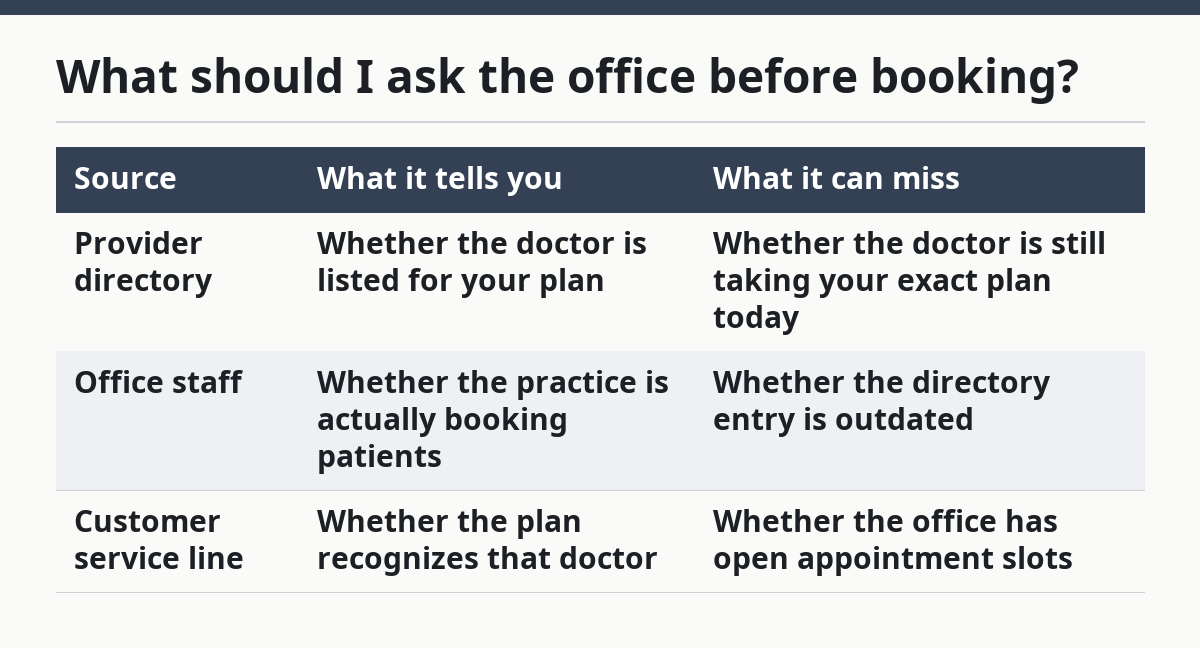
Here is a simple comparison of what each source tells you:
| Source | What it tells you | What it can miss |
|---|---|---|
| Provider directory | Whether the doctor is listed for your plan | Whether the doctor is still taking your exact plan today |
| Office staff | Whether the practice is actually booking patients | Whether the directory entry is outdated |
| Customer service line | Whether the plan recognizes that doctor | Whether the office has open appointment slots |
A 5-minute phone call is often enough to clear up the mismatch. Say the doctor’s name, the plan name exactly as shown on your card, and the date you want care. If the office uses a different name for the network, write it down.
The cost of skipping this step is not just inconvenience. It can mean a canceled appointment, a longer wait, or a bill you did not expect. A quick call is a small task compared with sorting out a claim later.
What if the doctor is in network but not taking new patients?
If the doctor is in network but not taking new patients, keep searching and do not book as if the answer is yes. That status means the billing side may work, but the office cannot place you on the schedule yet.
This is one of the most common traps for new plan members. A listing that says “in network” can sound final, but “accepting new patients” is a separate question. The same is true for specialists, who may be in network but booked far ahead or only seeing established patients.
If the office is full, ask for the next closest in-network doctor in the same specialty or ask whether they keep a waitlist. You can also widen your search to another location of the same practice group if your plan allows it. Some practices keep one doctor full while another doctor in the same office still has openings.
This is where patience helps, but only to a point. If you need care soon, choose the doctor who can see you, not the one who merely looks best on paper. A plan network is useful only when it connects you to an actual appointment.
Can I change doctors later?
You can usually change doctors later, and many freelancers do when their care needs change or when a closer in-network doctor opens up. That said, the easier move is to make a workable first choice now and switch only if the fit is poor.
The reason this matters is simple: a doctor is not just a name in a directory. You may need time to build a record, transfer notes, and learn how the office handles referrals, renewals, and follow-up. Changing later is normal, but changing every few weeks is a hassle you do not need.
A few reasons people switch include a move, a schedule mismatch, a doctor who is not taking new patients anymore, or a better fit with a specialist or primary care doctor. If you switch, make sure the new doctor is still in your health plan network before you book. That keeps the transition focused on care, not billing.
If your plan gives you a member portal, check whether it stores past searches or saved doctors. That can make a second search faster by keeping the names you already ruled out. The aim is not to find a perfect doctor in one shot; it is to find a real one who is available, in network, and reasonable to reach.
FAQs
How do I know if a doctor is in network?
Use the provider directory first, then confirm it with the office or your plan’s customer service line. A doctor can be listed in the directory and still be out of date, so the safest check is a match between the directory entry and the office’s current status. If both say yes, you are on much firmer ground.
Should I call the office after checking the directory?
Yes, because the office knows whether the doctor is still accepting new patients and whether your exact plan is accepted. The directory is useful, but it can lag behind changes in staffing or plan participation. A 2- to 5-minute call can prevent a canceled booking or a surprise billing problem.
Can I change doctors later?
Yes, most people can change doctors later if their plan allows it and the new doctor is in network. That said, you still need to verify the new doctor before booking. If you switch, ask the new office how they handle records, referrals, and first appointments so the move does not create a gap in care.
Drafted with AI; not yet reviewed by a person.