
Last updated: November 27, 2026
An HMO is usually the better pick for freelancers who want predictable monthly costs, because it tends to keep the bill structure simpler and easier to plan around. A PPO can still fit if flexibility matters more than a steady monthly budget, but the extra moving parts can make the total cost harder to guess.
Key takeaways
- Predictable monthly cost is about how easy the plan is to budget, not just the premium alone.
- Both HMO and PPO premiums are 100% tax-deductible for self-employed people within IRS limits, according to Lettuce.
- An HMO usually fits a freelancer who wants fewer billing surprises and is fine with tighter rules.
- A PPO fits a freelancer who wants more choice and can tolerate less certainty in the final bill.
- If you are in ongoing treatment, Medicare says a new plan must give at least 90 days before requiring new prior approval for that care.
What does predictable monthly cost mean?
Predictable monthly cost means you can guess your health insurance bill without a lot of surprises. For freelancers, that usually means the premium matters most, but copays, deductibles, and coinsurance can still change what the plan actually costs in a bad month.
An HMO usually gives the cleaner budgeting picture because it is built around tighter rules and a more controlled cost structure. A PPO often buys more freedom, but that freedom can make the monthly bill less even when the premium itself is easy to see.
This is why the right question is not “which plan is cheaper?” It is “which plan lets me set aside the same amount each month without worrying about a bigger surprise later?”
HMO and PPO side by side
The real difference is that an HMO trades flexibility for more cost control, while a PPO trades cost control for choice. That trade-off matters most when a freelancer is trying to keep a stable monthly budget, not just chase the lowest sticker premium.
| Criteria | HMO | PPO | Winner for predictable monthly costs |
|---|---|---|---|
| Monthly premium | Usually the simpler budget line | Often costs more in exchange for flexibility | HMO |
| Billing complexity | Fewer moving parts | More moving parts | HMO |
| Copays | Often easier to plan for | Can vary more by how care is used | HMO |
| Deductible exposure | Can still matter, but the plan often feels more controlled | Can be harder to budget for because more care may run through the plan differently | HMO |
| Coinsurance exposure | Usually less of a budgeting headache | Can add uncertainty after the deductible | HMO |
| Provider choice | Tighter rules | More flexibility | PPO for choice, not for predictability |
| Self-employed tax treatment | Premiums are 100% tax-deductible within IRS limits, according to Lettuce | Premiums are also 100% tax-deductible within IRS limits, according to Lettuce | Neither |
| Best fit | Freelancers who want steady monthly planning | Freelancers who value flexibility over simplicity | HMO |
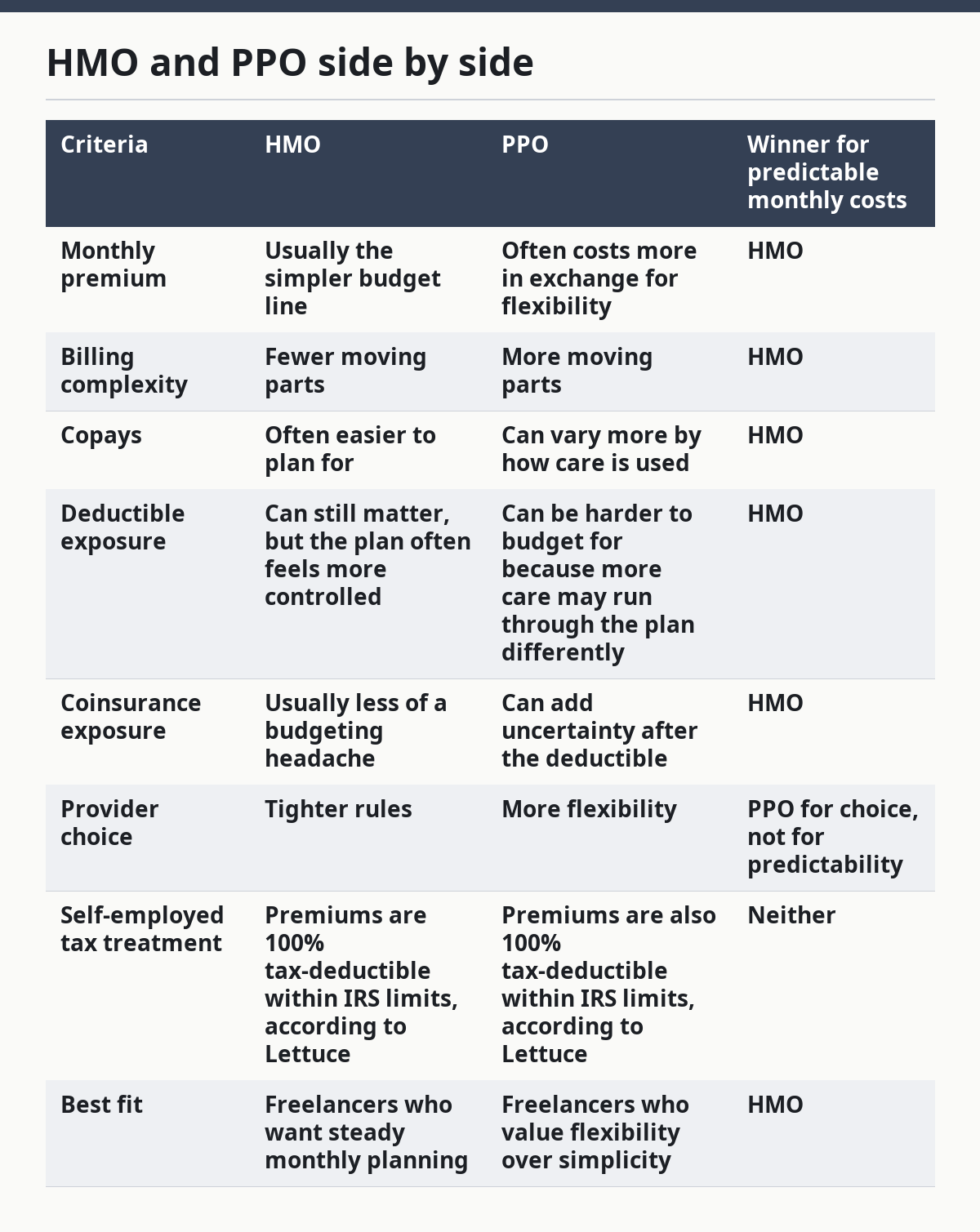
That table is the core of the decision. If the goal is a more predictable monthly plan, HMO wins on structure. If the goal is choice, PPO wins, but that is not the same thing as predictability.
Why an HMO usually wins for budgeting
An HMO usually wins for budgeting because it keeps the cost picture narrower. A freelancer who hates surprise bills is often better off with a plan that puts more of the decision-making on the plan itself and less on the member.
The biggest strength is not that every bill disappears. It is that the member has fewer paths for costs to drift. Premiums still matter, and copays still matter, but the overall structure is easier to hold in mind from month to month.
The downside is real. HMOs are less forgiving if a freelancer wants broader provider choice or wants to keep using a provider outside the plan’s usual structure. That can matter a lot if the person already has care in progress or wants maximum freedom to choose where to go.
For the freelancer who wants a plan they can set and forget, that trade-off often makes sense. For the freelancer who wants the most freedom to choose doctors and still keep costs easy to predict, the HMO can feel too tight.
Why a PPO still makes sense for some freelancers
A PPO wins when flexibility matters more than cost predictability. That is the right fit for a freelancer who cares about seeing a wider range of providers and is willing to accept a less certain monthly total.
The strength of a PPO is choice. That choice can matter if a freelancer has an established care pattern, wants more options, or expects to use medical care in ways that do not fit neatly into one network structure. That same flexibility is also the weakness, because more choice usually means more room for cost variation.
The budget drawback is simple: a PPO can be harder to plan around. Even when the premium is clear, the rest of the bill can be less stable because the plan leaves more room for different cost paths through care, deductibles, and coinsurance.
There is also a tax point that does not favor one plan over the other. For self-employed individuals, both HMO and PPO premiums are 100% tax-deductible within IRS limits, according to Lettuce. That means the tax break does not solve the predictability question by itself.
A PPO is not the wrong choice just because it is less predictable. It is the wrong choice for a freelancer whose main goal is a steady monthly number and who does not need the extra flexibility.
What the tax deduction changes
The self-employed tax deduction can lower the real cost of either plan, but it does not change which plan is easier to budget for. Lettuce says self-employed individuals can deduct 100% of health insurance premiums from taxable income, regardless of plan type.
That matters because a PPO with a higher monthly premium may still reduce taxable income, just like an HMO does. Lettuce gives the example of an HMO at $400 monthly or a PPO at $600 monthly, and says both reduce taxable income, up to net self-employment earnings.
The practical point is this: the deduction can soften the cost of either plan, but it does not make the cash flow the same. A freelancer still has to pay the premium each month before the tax benefit shows up later.
So the tax rule should not be used as a reason to ignore the monthly bill. It should be treated as a partial offset, not a budgeting strategy.
When would the choice flip?
The overall verdict flips in a few real situations, and those situations matter more than a generic plan comparison. The first is when provider choice is the top priority. If the freelancer needs broad access and is willing to give up some predictability, PPO becomes the better fit.

The second is when care is already underway. Medicare says that if a person switches plans while in treatment, the new plan must give at least 90 days before requiring new prior approval for ongoing treatment. That does not erase the hassle of switching, but it does reduce one of the biggest short-term risks.
The third is when a freelancer has a monthly budget that can absorb variation, but a tight doctor choice requirement. In that case, predictability is no longer the only goal, and PPO can win on the bigger life fit.
The fourth is when the freelancer simply cannot stand paperwork and prefers the simplest monthly planning. That is the strongest HMO case, and it often wins even if the HMO is not the most flexible plan on paper.
Which one should a freelancer choose?
Choose HMO if the goal is the steadiest monthly budget and the freelancer can live with tighter rules. Choose PPO if the freelancer wants more provider choice and can accept more cost variation. Neither if the freelancer is trying to solve a care-transition problem without first checking how the plan handles ongoing treatment.

That is the plain answer for predictable monthly costs. HMO is the better match for most freelancers who want a bill they can plan around. PPO is the better match only when flexibility matters enough to outweigh that predictability.
If a freelancer is comparing this choice with the broader HMO vs PPO question, that hub can fill in the bigger picture. This page is the budgeting answer: the plan that usually feels steadier month to month is the HMO.
What about ongoing treatment and plan changes?
A plan change can be risky if treatment is already in progress, and that risk can affect monthly cost planning. Medicare says a new plan must give at least 90 days before requiring new prior approval for ongoing treatment when a person switches plans while in treatment.
That detail matters because a freelancer may think the premium is the only fixed part of the deal. It is not. A treatment change can bring paperwork, timing issues, and a temporary burst of uncertainty even if the premium stays the same.
This is one more reason the most budget-focused freelancer should favor the simpler option before a switch happens. Stability is easier to keep when the care situation is calm.
Which plan type usually has lower monthly premiums?
An HMO usually has the lower monthly premium, but the premium alone does not tell the whole story. Copays, deductibles, and coinsurance can still change what the plan costs in a given month. For a freelancer who wants predictable monthly costs, the lower premium is helpful only if the rest of the plan stays easy to budget for.

Which plan type is easier to budget for?
An HMO is usually easier to budget for. It tends to have a more controlled cost structure, so the monthly bill is easier to plan around than a PPO. That does not mean every expense is fixed, but it usually means fewer surprises for someone trying to keep a steady freelance budget.
How do copays change between HMO and PPO plans?
Copays often feel more predictable in an HMO because the plan is built around tighter cost controls. In a PPO, copays can be part of a less certain total because more of the bill can vary with how care is used. A freelancer should look at the copay only as one piece of the monthly cost picture, not the whole answer.
Sources
- medicare.gov, Health Maintenance Organizations (HMOs) – Medicare (checked 27 Nov 2026)
- lettuce.co, HMO vs. PPO for the Self-Employed: Which Is Right for You? (checked 27 Nov 2026)
Drafted with AI; not yet reviewed by a person.