
Last updated: November 28, 2026
Quick answer: for many freelancers with kids, an HMO is the simpler choice if it keeps 1 primary care physician and 1 pediatrician in the same network; a PPO is better if the family needs more than 1 doctor choice or expects changes during the year. For a freelancer with kids, HMO vs PPO with family doctors and kids: how freelancers decide comes down to whether the plan keeps the family doctor situation simple instead of turning every appointment into a routing problem.
Key takeaways:
- An HMO fits families who want 1 care team, fewer moving parts, and a clear place to start for most visits.
- A PPO fits families who need more doctor choice and less friction when a child’s care changes during the year.
- If you already have a pediatrician you do not want to lose, the network matters more than the plan label.
- A freelancer should think about the whole household, not just their own doctor visit pattern.
- The wrong plan is the one that forces a parent to switch doctors for the kids or split care across too many offices.
I write about health-plan comparisons for self-employed readers, so the real question here is not “Which plan sounds better?” It is “Can one plan keep the whole family’s care coordinated without adding avoidable stress?” For basics on plan types, the federal marketplace overview at HealthCare.gov is the cleanest starting point. For timing, open enrollment dates for freelancers also matter because plan choice usually has a deadline.
What actually changes for a freelancer with kids?
An HMO usually wins on simplicity, while a PPO usually wins on flexibility. That difference matters more for a family than for a single adult because kids create more repeat visits, more handoffs, and more calendar pressure.
For a freelancer, the practical question is not the plan title. It is whether the household can stay with the same primary care physician, keep the same pediatrician, and get care from the same network without constant shuffling. A family with 2 children may need the pediatrician office more often than the parent sees their own doctor, so the child side of the plan can become the deciding factor.
The cleanest way to think about it is this: an HMO tends to ask the family to stay inside 1 system, while a PPO tends to let the family spread out more. That spread can help if 1 child already sees a doctor you like and another parent prefers a different doctor. It can also make scheduling harder because the household is no longer working with 1 predictable care team.
A generic article usually talks only about “lower cost” or “more flexibility.” That misses the family routing problem. The routing problem is whether a parent can make 1 phone call, get 1 appointment, and keep the child’s doctor and the parent’s doctor aligned. That is where the difference shows up in real life.
HMO vs PPO for family care: side by side
An HMO is the better fit when the goal is 1 coordinated home base for the family’s medical care. A PPO is the better fit when the family values choice more than consolidation.
| Criteria | HMO | PPO | Winner for this condition |
|---|---|---|---|
| Keeping 1 family doctor relationship | Usually stronger if the doctor is in the network | Often easier if you want a wider set of doctors | HMO for 1 stable care team |
| Keeping the same pediatrician | Good if the pediatrician is in-network and the family stays local | Good if you want more choice among pediatricians | HMO if you already have a preferred pediatrician |
| Family scheduling | 1 system can make repeat visits easier to coordinate | More choice can mean more scattered scheduling | HMO for busy households |
| Care coordination for dependents | Usually more centralized around a primary care physician | Often less centralized, with more freedom to book elsewhere | HMO for coordinated family care |
| Switching doctors midyear | Harder if the family wants a doctor outside the network | Easier to move among doctors in the network | PPO if change is likely |
| Household with mixed doctor preferences | Less flexible when family members want different doctors | Better when parent and kids need different specialists or offices | PPO for mixed preferences |
| Administrative simplicity | Usually simpler if the family stays put | Usually more moving parts because there are more choices | HMO for low-friction planning |
| Best fit for a freelancer’s schedule | Stronger if the freelancer wants predictable routing | Stronger if the freelancer’s work pattern changes a lot | HMO for routine care, PPO for fluid schedules |
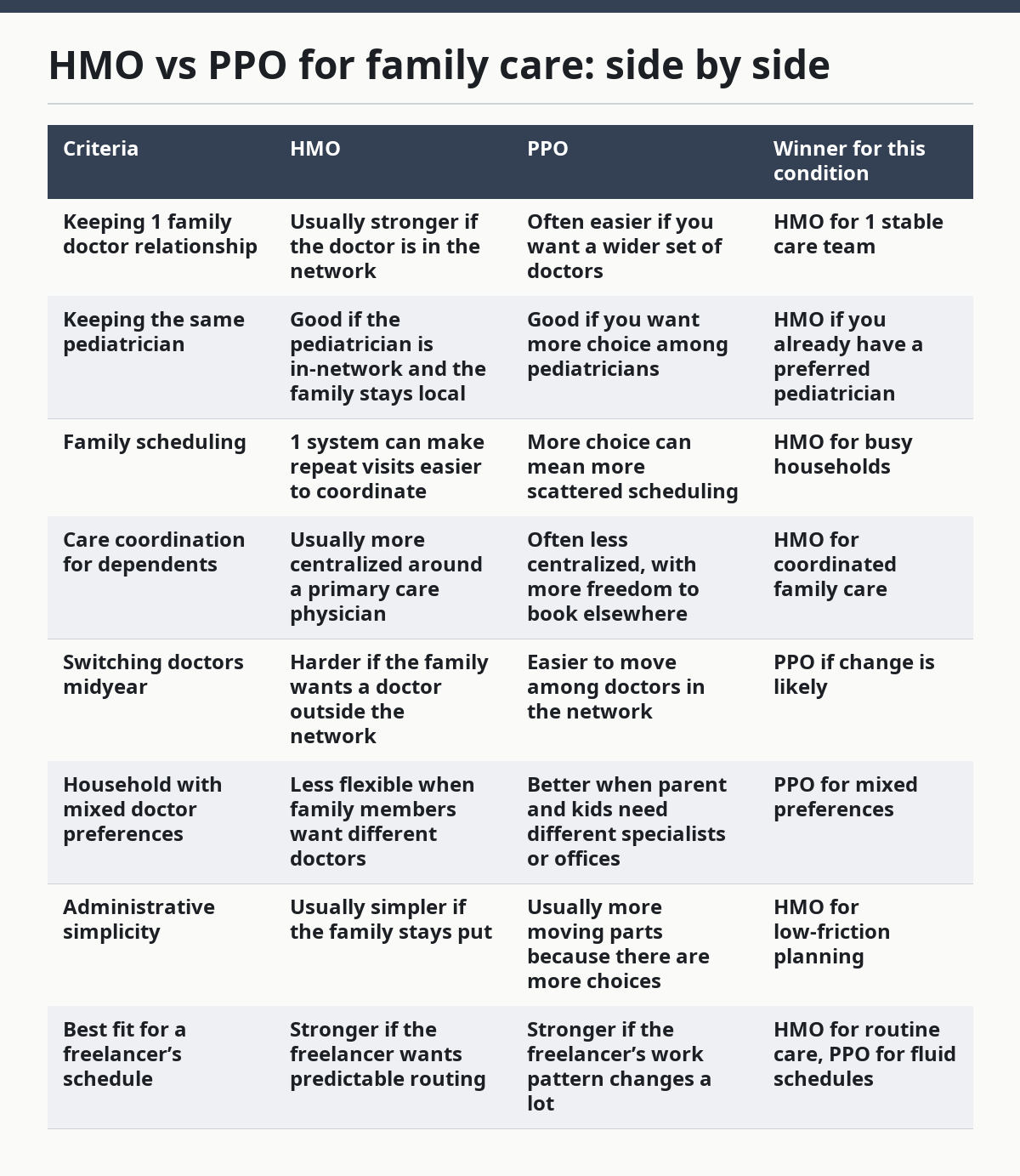
The table points to a clear pattern: HMO for 1 care home, PPO for 1 family that needs more room to spread out. That is why the choice is less about insurance jargon and more about how many people are involved, how often they go in, and whether 1 pediatrician can serve the whole household.
Why an HMO fits some families better
An HMO wins for freelancers who want 1 primary care physician to anchor the family. That setup is useful when a parent has 2 kids, 1 pediatrician, and a routine that does not change much from month to month.
The biggest strength is coordination. A single care team can make it easier to keep records, repeat prescriptions, and child visits under 1 roof. That matters when 1 parent is balancing client work, school pickup, and a sick child who needs a follow-up in the same week. The family does not have to manage as many separate doctor relationships.
The weakness is rigidity. If the child’s preferred pediatrician is not in the network, or if the parent already has a doctor they trust outside it, an HMO can force a choice that feels personal, not financial. That is the drawback people underestimate. The plan may be tidy on paper, then awkward in real life when the family is already attached to a doctor.
An HMO is best for a freelancer who wants the fewest moving parts, can keep the family inside 1 network, and likes having 1 main office to call. It is not a good match for a family that expects to bounce between doctors or wants the freedom to shop around if a child needs a different specialist later.
For plan basics, the federal government’s HealthCare.gov plan comparison tools are useful because they show the structure, not just the marketing language. The National Association of Insurance Commissioners also explains plan structures for consumers.
Why a PPO fits some families better
A PPO wins when the family needs more flexibility around doctors and pediatric care. For freelancers, that can matter when work hours shift, kids change schools, or 1 family member already has a doctor they want to keep.

The main strength is choice. If 1 child has been seeing a pediatrician the family trusts, a PPO can make it easier to keep that arrangement without reorganizing the whole household’s care pattern. It also gives the parent more room if their own primary care physician is outside the tightest plan network. For a freelancer, that flexibility can save time because the family is not forced into 1 path for every visit.
The weakness is that flexibility can make the plan feel looser and less coordinated. When there are more options, there are more chances for the family to book care in different places and lose that 1-home-base feeling. That can matter when a parent is already managing 2 school calendars and a freelance deadline.
A PPO is the better pick for a freelancer with kids when doctor choice is the priority, when the family already has preferred providers, or when the household is likely to change care patterns during the year. It may not be the best fit for a family that wants 1 tidy system and does not want to think about provider choice every time someone needs an appointment.
The comparison here is not about which plan is “better” in the abstract. It is about whether the family wants 1 center of gravity or a wider circle of options.
When does the choice flip?
The verdict flips in 4 common cases, and these are the situations a generic article often ignores.
First, if the family already has a pediatrician they would rather not lose, that can outweigh the usual HMO-versus-PPO logic. A plan that keeps 1 child’s doctor in reach is often worth more than the label on the card.
Second, if the freelancer’s work schedule changes from week to week and the family has to book care fast, the added flexibility of a PPO can matter more than a neater network setup. A parent who can only make midday appointments may need more room to move.
Third, if 2 kids need care from different doctors and 1 parent wants a different primary care physician for themselves, the PPO can keep the household from feeling boxed in. A mixed-family setup often strains the HMO model.
Fourth, if the freelancer is trying to keep 1 simple care team and avoid extra coordination work, the HMO still wins even when the PPO looks more flexible on paper. More choice does not help if the family wants fewer decisions.
The pattern is clear: the more unified the family’s care needs, the more an HMO fits. The more varied the household’s doctor preferences, the more a PPO fits.
Choose HMO if, choose PPO if
Choose HMO if you want 1 primary care physician, 1 pediatrician in the same network, and a simpler way to manage dependent care. Choose PPO if your family already uses different doctors, wants more provider choice, or expects to change care during the year. Neither if you are choosing only by label and have not checked whether the family doctor and pediatrician are actually available.
That is the cleanest freelancer rule. Start with the doctors the family already uses, then decide which plan type keeps them together with the least friction.
What a freelancer should check before deciding
An HMO or PPO decision should be made after checking the family’s actual doctors, not before. The first thing to verify is whether the current primary care physician and pediatrician are in the plan’s network. The second is whether the plan will keep the whole household together or split care across different offices.
A freelancer should also think about the age of the kids and how often they go in. A family with 1 toddler and 1 school-age child may need more routine visits than a family with older children. That difference can make coordination more valuable than flexibility.
It also helps to ask 1 plain question: if 1 child needs a different doctor later, does this plan still feel manageable? If the answer is no, the PPO may be worth the extra flexibility. If the answer is yes because the family already likes 1 clinic, the HMO is usually the cleaner choice.
For more background on how these plan types work, HealthCare.gov’s plan-type pages are useful, and the National Association of Insurance Commissioners also explains plan structures for consumers.
Is an HMO or PPO better for a freelancer with kids?
An HMO is usually better if the freelancer wants 1 simple care setup for the whole family. A PPO is usually better if the family needs more doctor choice or expects to use different providers. The better plan is the one that keeps the family doctor and pediatrician situation easiest to manage, not the one with the fancier label.
Can a freelancer keep the same family doctor on an HMO?
Yes, if that family doctor is in the HMO network. The key issue is not the title HMO itself but whether the doctor is included in that plan’s list of covered providers. If the doctor is outside the network, the family may need to change plans or change doctors.

Do PPOs make it easier to cover a child’s specialist visits?
Often, yes, because PPOs usually give families more flexibility in choosing providers. That said, the child’s exact doctor still has to fit the plan’s rules, so the family should check the network before assuming anything. For a child with ongoing care, the main question is whether the current pediatrician and follow-up doctors stay usable under the plan.
Drafted with AI; not yet reviewed by a person.