Last updated: November 19, 2026
How freelancers compare Marketplace plans before applying starts with a quick answer: compare at least 3 plans, then check premium, deductible, copays, network, and drug coverage before you apply. Freelancers compare Marketplace plans by lining up the plan documents, doctors, drugs, and likely out-of-pocket costs before they submit an application. The fastest way to do it is to use the marketplace plan comparison screen as a filter, then read the summary of benefits and coverage, provider directory, and drug formulary side by side. For official Marketplace guidance, see HealthCare.gov and the CMS glossary and plan pages. HealthCare.gov CMS
Key takeaways
- Start with the marketplace comparison screen, then narrow by county, household size, and coverage date so you are comparing the right plans.
- The monthly premium is only one line item; the deductible, copays, coinsurance, and out-of-pocket maximum change what a plan really costs.
- A provider directory can look fine until you check your exact doctor, clinic, and hospital name; that is where many mismatches show up.
- Drug coverage matters even if you take only one prescription, because a plan can cover the drug but still place it on a higher tier or require prior authorization.
- The summary of benefits and coverage is the shortest way to compare the same service across plans without reading every policy document.
- If your income, household size, or county may change soon, compare plans again before applying; a plan that fits today may not fit next month.
What freelancers should compare first in the Marketplace plan comparison process
Freelancers should compare estimated total cost first, not the premium alone. A plan with a lower monthly premium can cost more over a year if it has a higher deductible, narrow network, or expensive prescriptions.
For freelancers, the marketplace comparison process works best when it starts with the care you actually expect to use in the next 12 months. That means comparing:
- routine primary care visits,
- any specialist visits you already know about,
- prescriptions you take every month,
- emergency room exposure,
- and any planned imaging, surgery, or therapy.
The right comparison set is usually 3 to 5 plans, not 20. Too many choices make it harder to notice the difference between a plan that looks cheap and one that is cheap only until you use it. A practical comparison should also stay inside one marketplace for one county and one effective date. Mixing service areas gives you a false comparison.
If you want a clean decision, compare one doctor, one medication, one likely event, and one worst-case scenario. That four-part check will surface the real trade-off faster than staring at the premium column. A plan that saves $30 a month but adds a $60 specialist copay and a poor formulary can lose quickly.
How freelancers use the marketplace plan comparison screen
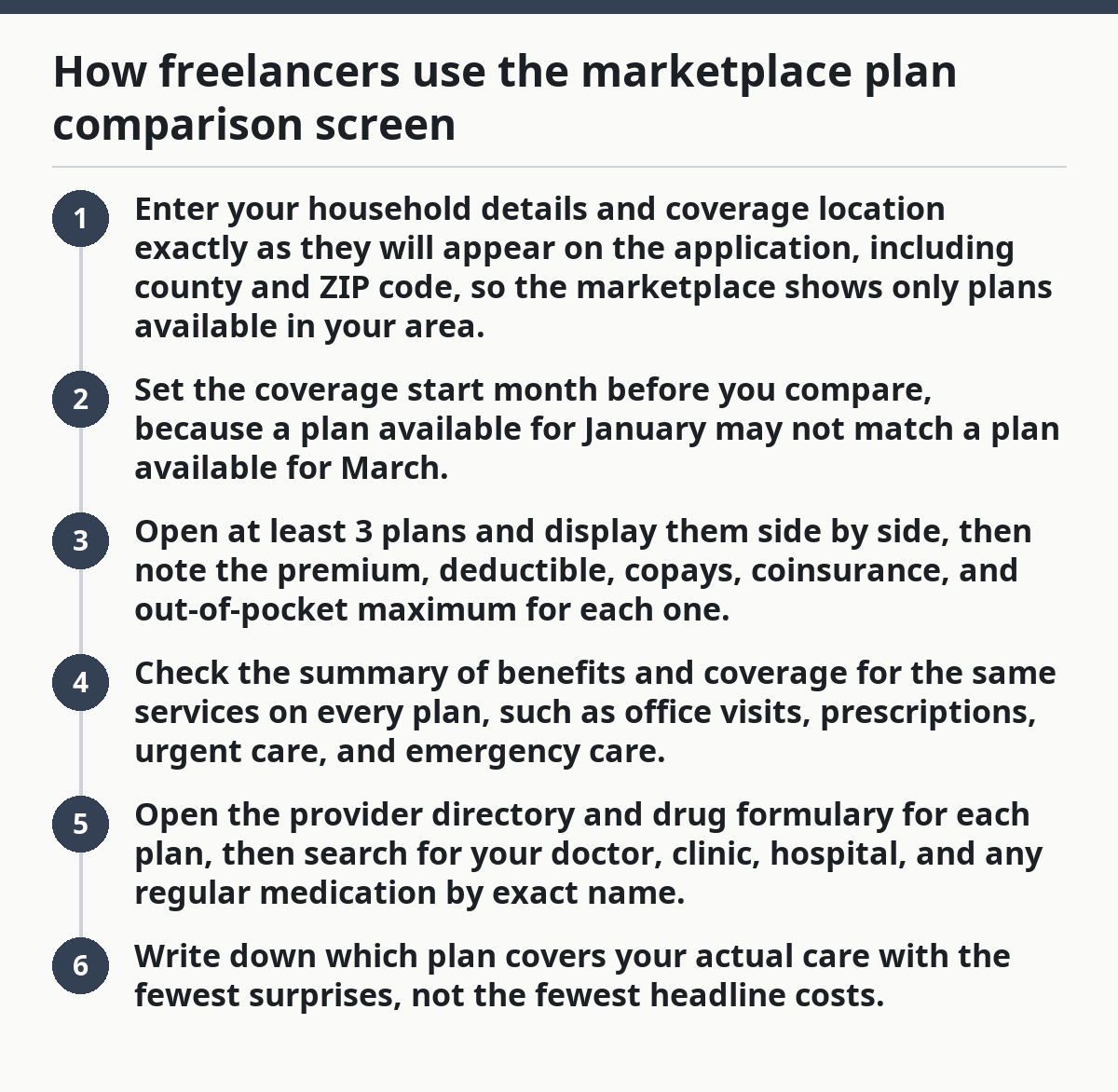
How freelancers use the marketplace plan comparison screen is by entering the same personal details for every plan, then sorting the results by the costs that matter to you. The point is to make the marketplace do the filtering before you read a single policy page.
Use this order:
- Enter your household details and coverage location exactly as they will appear on the application, including county and ZIP code, so the marketplace shows only plans available in your area.
- Set the coverage start month before you compare, because a plan available for January may not match a plan available for March.
- Open at least 3 plans and display them side by side, then note the premium, deductible, copays, coinsurance, and out-of-pocket maximum for each one.
- Check the summary of benefits and coverage for the same services on every plan, such as office visits, prescriptions, urgent care, and emergency care.
- Open the provider directory and drug formulary for each plan, then search for your doctor, clinic, hospital, and any regular medication by exact name.
- Write down which plan covers your actual care with the fewest surprises, not the fewest headline costs.
This process takes more than 10 minutes if you do it carefully, and that is normal. The result should be a short list of plans that fit your care pattern, not a guess based on price alone.
One useful habit is to compare the same service across all plans before moving to the next one. For example, compare a primary care visit first, then a specialist visit, then a generic prescription, then an emergency room visit. That keeps the plans aligned.
What does the summary of benefits and coverage tell me?
The summary of benefits and coverage tells you how a plan handles common care in a standard format, so you can compare plans without decoding the whole policy. It is the clearest place to check what you will pay for visits, tests, prescriptions, and emergency care.
A generic plan brochure can sound generous, but the summary of benefits and coverage may show a $40 specialist copay, a $500 deductible for some services, or separate cost-sharing for imaging. That document is where the useful differences live. It usually gives you the numbers you need for a direct comparison: office visit copays, deductible amounts, coinsurance percentages, and out-of-pocket maximums.
Read it with a marker, not like a sales flyer. Look for:
- primary care visit cost,
- specialist visit cost,
- telehealth or virtual care treatment if you use it, and check it against the plan documents or a licensed navigator if you are unsure,
- urgent care and emergency room cost,
- generic and brand-name drug cost,
- diagnostic tests such as X-rays or blood work,
- and any service that needs prior authorization.
The summary is also where you can catch benefit limits that are easy to miss. If physical therapy, mental health care, or imaging matters to you, the plan may have different cost-sharing than the rest of the schedule. That is the sort of detail that can turn a “cheap” plan into a poor fit.
A plan is not automatically better because its summary is shorter or easier to read. Short documents can still hide expensive cost-sharing. The advantage of the summary is consistency, not generosity.
How do I check provider networks without getting fooled?
How do I check provider networks without getting fooled? You check provider networks by searching for the exact doctor, clinic, and hospital name in the provider directory, then confirming that the search result matches your plan and service area. The network check only counts if it matches the plan you are applying for, not a similar plan from the same insurer.
Do not rely on a clinic logo, a marketing page, or a broad “accepts this marketplace plan” statement. Network directories can be out of date, and some offices have one in-network location and one out-of-network location under the same brand. That matters most if you need a specialist, surgery center, or hospital system tied to your care.
Use this practical check:
- search by full name, not only specialty,
- check the location and phone number,
- confirm the plan name exactly as shown in the marketplace,
- and if the directory is unclear, call the office and ask whether they take that plan for the service you expect.
The most common mistake is assuming every doctor in a group practice is in network because one doctor is. That assumption can cost you at the point of care. Another mistake is ignoring the hospital. A doctor can be in network while the facility is not.
If your care depends on one physician or one health system, network fit matters more than a small premium difference. If you do not have a regular doctor, you can place less weight on the network and more on cost-sharing and drug coverage. That is one of the few times a narrow network may be acceptable.
How do I compare drug formularies before I apply?
How do I compare drug formularies before I apply? You compare drug formularies by checking whether each medicine is covered, what tier it sits on, and whether the plan requires prior authorization or step therapy. This is a reliable way to avoid a plan that looks fine on paper but makes your prescription expensive or hard to fill.
Start with the exact drug name, dose, and form. “Metformin” is not enough if you take extended-release tablets and a plan lists only a different form. The same goes for inhalers, injectables, and combination medicines. Then look at the formulary to see whether the drug is:
- covered at all,
- placed on a preferred or nonpreferred tier,
- subject to prior authorization,
- or limited to a specific quantity.
Drug coverage is one place where a low premium can be misleading. A plan can cover a medicine and still make it hard to use because of tiering or utilization rules. If you take one maintenance prescription every month, even a small change in formulary status can affect the plan choice.
I would also compare preferred pharmacies if the plan lists them. Some plans price the same drug differently depending on where you fill it. That difference can be large enough to change the value of the plan, especially for recurring prescriptions. The formulary and pharmacy rules belong in the same comparison, not separate tabs.
For a freelancer who uses no prescriptions, this section still matters if medication use could change during the year. A plan with a weak formulary is riskier for someone with an ongoing condition, and it is the wrong fit if the plan makes a known drug unavailable.
What estimated total cost should I calculate before applying?
What estimated total cost should I calculate before applying? You should calculate your estimated total cost as premium plus likely care costs, because that is the number that reflects the plan’s real price to you. The result is a rough annual figure, not a promise, but it is much more useful than the monthly premium alone.
Use a 12-month estimate and include:
- monthly premium × 12,
- expected primary care visits,
- expected specialist visits,
- expected prescriptions,
- one urgent care or emergency room visit if that is realistic for you,
- and any likely imaging, labs, or therapy.
Then compare that estimate against the plan’s deductible, copays, coinsurance, and out-of-pocket maximum. The deductible tells you when the plan starts sharing more of the bill for certain services. Copays and coinsurance tell you how much you still pay after that. The out-of-pocket maximum gives you a ceiling for covered in-network spending, though the plan may still have rules outside that limit.
This is where freelancers often get tripped up. A plan with a low premium and high deductible can look attractive if you are healthy, but a single specialist-heavy year can change the math quickly. A plan with a higher premium may cost less in the end if you know you will use care regularly.
If you do not know your likely use, estimate from the last 12 months or from a realistic calendar of upcoming care. Guessing “none” is usually the least accurate answer. If you expect a major procedure, prescription change, or pregnancy-related care, this estimate should be revisited with a licensed insurance navigator or other qualified professional before you apply.
When should a freelancer skip a plan, even if it looks cheap?
When should a freelancer skip a plan, even if it looks cheap? A freelancer should skip a plan if the doctor, drug, or hospital fit is wrong, even when the premium is low. A cheap plan that breaks your care pattern is not a bargain.
This is especially true if:
- your current doctor is out of network,
- your regular medication is missing from the formulary,
- the plan requires step therapy for a medicine you already use,
- the deductible is far higher than you can absorb,
- or the out-of-pocket maximum is too high for your budget.
The other warning sign is a plan that only works if nothing unexpected happens. That is not a plan; it is a bet. If you are a freelancer with unstable income, a plan that depends on perfect health can leave you exposed when work is slow and medical bills arrive together.
The right move is to pass on the attractive headline and choose the plan that protects the care you actually use. If two plans are close, pick the one that better matches your doctor network and prescriptions before you think about the monthly payment. That order keeps the comparison grounded in the marketplace plan comparison process instead of marketing language.
What should I compare besides the monthly premium?
What should I compare besides the monthly premium? Compare the deductible, copays, coinsurance, out-of-pocket maximum, provider network, and drug formulary. Those five items determine whether the plan is usable when you need care, while the premium only tells you the monthly bill. A plan with a lower premium can still cost more once you add doctor visits and prescriptions.
How do I know if my doctor is in network?
How do I know if my doctor is in network? Search the plan’s provider directory using your doctor’s full name, location, and practice name. Then confirm the match for the exact plan you want, not just the insurer brand. If the directory is unclear, call the office and ask whether they accept that marketplace plan for the service you need.
Drafted with AI; not yet reviewed by a person.