How freelancers prove residence for state Marketplace coverage

Last updated: November 20, 2026
Key Takeaways
- Freelancers prove residency with one recent document that matches their name and in-state address, then reply quickly to notices.
- A mailing address can differ, but the home address must support residency.
- Moves often trigger extra residence checks.
- Rejections usually happen when the name, address, date, or scan quality does not match.
- What the Marketplace wants to see first
- How do freelancers handle proof of residence when applying for state Marketplace coverage?
- Mailing address vs home address: what the system actually checks
- What to send if you just moved to a new state
- What gets a proof of residence document rejected
- How to respond to a verification notice without losing time
- What documents work best for freelancers, and what should you avoid?
Freelancers applying for state Marketplace coverage usually need a document that shows a physical home address in that state, not just a mailing address. For how freelancers handle proof of residence when applying for state Marketplace coverage, the usual check is a document tied to your name and in-state address. A utility bill, lease agreement, or driver license may work, but state rules vary. The steps below show what to send, what gets rejected, and how to avoid a delay.
What the Marketplace wants to see first
A state Marketplace wants proof that you live in the state where you applied, and it usually looks for a document dated within the last 60 days or another recent record tied to your address. That means the paper has to connect your name to a street address in that state, not just a P.O. box.
Picture this: you’re filling out an application at the end of a long workday, and the site asks for proof of residence before it will finish the review. The fix is usually simple—send one clear residency document that shows your name, your state address, and a recent date.
Common documents can include:
- a utility bill
- a lease agreement
- a driver license
- a bank statement
- a government letter with your address
The exact list can vary by state Marketplace, so don’t assume one form always wins. A driver license can help, but if the address on it is old, the system may still ask for a second document. A lease agreement can work well, yet some platforms want the page that shows both your name and the street address, not just a signature page.
The first move is usually to match the document to the address on your application. If you entered your apartment on Maple Street, your proof should show Maple Street too. A mismatch slows the case down.
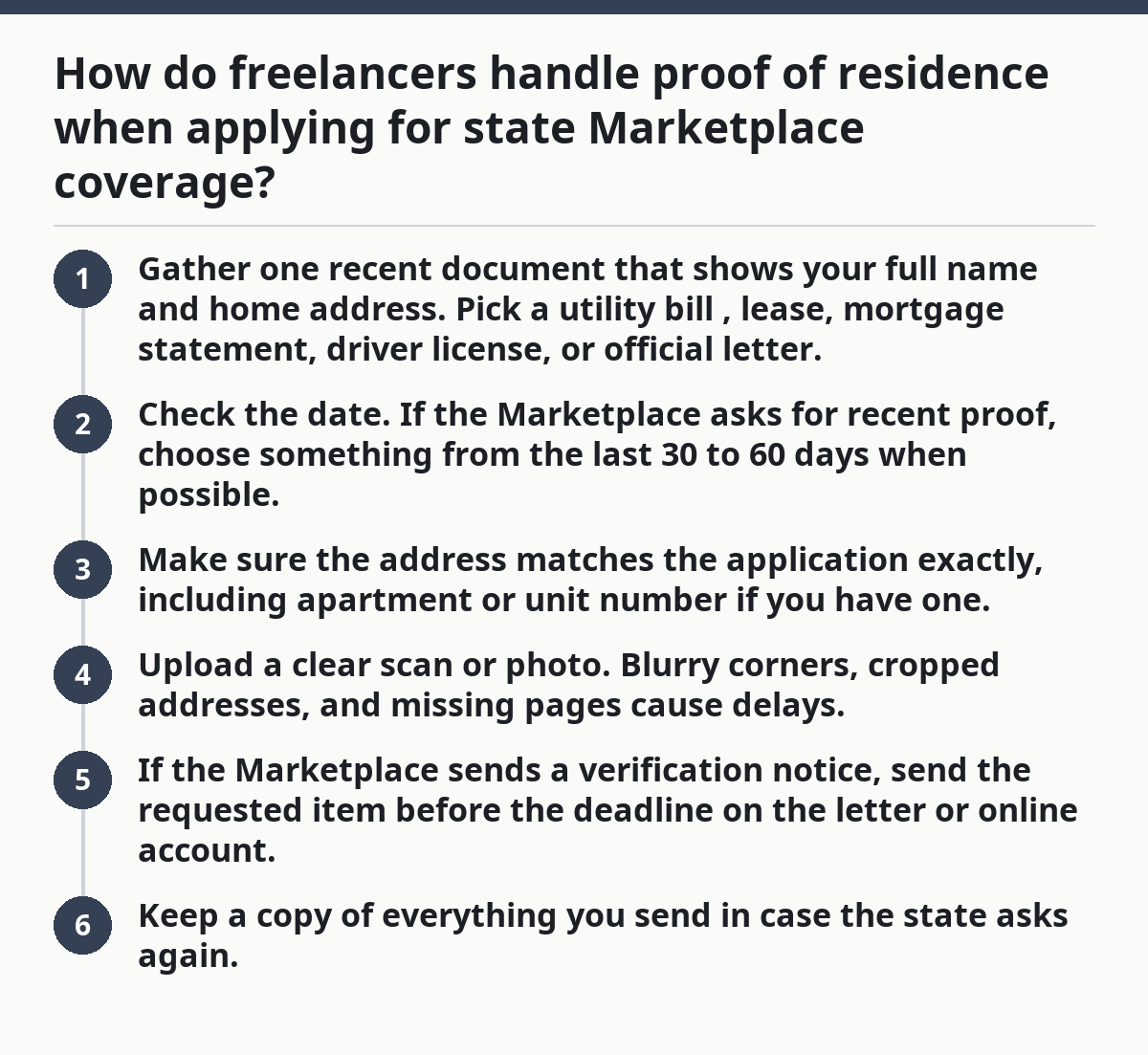
How do freelancers handle proof of residence when applying for state Marketplace coverage?
Freelancers handle proof of residence by sending a document that ties their name to a current in-state address, then answering any verification notice fast. The key is to treat this like a document check, not a tax question, and if the wording is unclear, consult a professional or the state Marketplace help line; HealthCare.gov explains that applicants may need to verify information before coverage is finalized, and IRS Publication 503 is an example of a government source on household records.
Picture this: you’re self-employed, you work from a laptop, and your income is easy enough to explain. The harder part is the address, because the Marketplace only cares that you live where you said you live. A clean file solves most of the problem.
Use this order:
- Gather one recent document that shows your full name and home address. Pick a utility bill, lease, mortgage statement, driver license, or official letter.
- Check the date. If the Marketplace asks for recent proof, choose something from the last 30 to 60 days when possible.
- Make sure the address matches the application exactly, including apartment or unit number if you have one.
- Upload a clear scan or photo. Blurry corners, cropped addresses, and missing pages cause delays.
- If the Marketplace sends a verification notice, send the requested item before the deadline on the letter or online account.
- Keep a copy of everything you send in case the state asks again.
A lot of freelancers trip over one small thing: they use a business mailing setup and assume it counts as home proof. It usually doesn’t. The system wants to know where you live, not where your invoices go.
If your first upload gets rejected, send a different document rather than the same one in a new file. One clean replacement often beats three shaky uploads. On the flip side, don’t start with a stack of six documents unless the notice asks for more. That can slow the review.
Mailing address vs home address: what the system actually checks

Your mailing address can be different, but your home address has to be the one that proves residency. The Marketplace cares about the place you live, not the place you receive mail.
Picture this: you’re using a coworking mailbox, a family member’s apartment, or a postal service box for deliveries. That setup may work for mail, but it can fail the residence check if the address is not your actual home. The rule is simple and annoying. The form needs your living address.
Here’s the catch: freelancers often mix up the address used for business with the address used for eligibility. A client-facing office, UPS mailbox, or virtual office usually will not show that you live in the state. A residency document should show your home street address, even if your business uses something else.
Good examples of a home-address match:
- your lease lists your apartment and unit number
- a utility bill shows your service address
- your driver license shows the same street address you entered on the application
Poor examples:
- a P.O. box by itself
- a mail-forwarding service address
- a coworking suite with no proof you live there
- a business registration address that is not your home
If you rent a room or share housing, that does not disqualify you. The document just has to connect you to the address you use as home. A landlord letter can help if the Marketplace accepts it, especially when your name is not on the utility account.
What to send if you just moved to a new state
If you just moved, send the newest document you have that shows your new address, then be ready to add a second paper if the first one is too fresh or incomplete. Moving is where most residence checks get sticky.
Picture this: you’re unpacking boxes and trying to finish coverage paperwork before the month ends. Your old lease, old license, and old utility bill all point to a different state. The Marketplace still can verify you, but only if you show the move with the right paperwork.
A strong move file often includes:
- a signed lease or move-in statement
- a utility start letter
- a new driver license or state ID request receipt
- a forwarding confirmation from the post office, if the state asks for it
The problem is timing. A brand-new utility account may not show up right away, and a new driver license may take weeks. In that gap, the Marketplace may ask for whatever you do have now. That can be a signed lease plus a bill from the new address, or a government letter tied to the new home.
Don’t wait for the “perfect” document if the notice deadline is close. Send the best current proof, then watch your account. If the state needs more, it will usually ask. Missing the deadline can pause or end the application.
For a freelancer who moves often, keep a folder with the lease, the first utility bill, and any official mail that arrives after the move. Those papers are the usual backbone of a residence file.
What gets a proof of residence document rejected
A proof of residence document gets rejected when the name, address, date, or file quality does not line up with the application. The rejection is usually about mismatch, not mystery.
Picture this: you’re uploading a photo from your phone, and the page looks fine until you zoom in. The apartment number is cut off, the address is partly shadowed, or the name on the bill is your partner’s name instead of yours. That is enough to trigger another request.
Common reasons for rejection:
- the address on the document is a P.O. box
- the document is older than the state allows
- the name on the paper does not match the application
- the address is missing an apartment, suite, or unit number
- the image is blurry, cropped, or unreadable
- the document is not the kind the state accepts
Some freelancers try to “explain” a bad document with a long note. The note may help, but it does not replace proof. The Marketplace wants the paper itself. If the account asks for a residency document, send a document, not a paragraph.
A second common problem is uploading the wrong page. A lease packet may have six pages, but only one page shows the address and your name. A bank statement may show the address on page 2. Send the page that proves the point, and include the rest only if the notice asks for it.
If the document is rejected, read the notice line by line. It usually says what is missing. That message is the shortest path back to approval.
How to respond to a verification notice without losing time
You respond to a verification notice by matching the document type, the deadline, and the name on the account exactly. That keeps the application moving and avoids a coverage gap.
Picture this: you’re checking your Marketplace inbox and there’s a notice asking for proof of residence by a set date. The deadline matters. A state Marketplace notice can ask for more than one thing, but the first job is to send the requested residency document before the deadline.
Use this checklist:
- open the notice and find the exact document request
- confirm whether the state wants an upload, mail-in copy, or both
- pick one document that shows your name and current address
- scan or photograph all needed pages in one file if the system allows it
- save the confirmation page or reference number after submission
The safest move is to submit early enough to fix a problem. If the file is rejected on a Friday night, you may lose two days before you can correct it. That matters when the notice gives you a short window.
Keep in mind that the Marketplace can ask for proof again if your address changes later. A freelancer who moves between short-term rentals, sublets, or seasonal housing should expect that possibility. That is not a penalty; it is the system checking for a current residence.
A useful rule: send the simplest paper that clearly proves the address. A clean utility bill or lease page is often better than a bundle of mixed files. Fewer pages, fewer mistakes.
For a broader explanation of eligibility rules that sit around this step, the hub guide on self-employed health insurance eligibility and enrollment rules is the better next read.
What documents work best for freelancers, and what should you avoid?
The best documents are the ones with your name, a street address, and a recent date in one place. The ones to avoid are the ones that prove business use, not home use.
Picture this: you’re sorting through a stack of PDFs and trying to guess which one the state will accept. Start with the document that looks most boring and official. That is often the winner.
Best-fit documents:
- utility bill in your name
- lease agreement with your name and unit
- driver license or state ID with the current address
- mortgage statement
- official government letter
Documents to avoid unless the notice specifically allows them:
- invoices
- client contracts
- business bank records with no home address
- P.O. box records
- rental listings that are not signed agreements
A freelancer’s tax papers can prove income, but not residence. The state uses those records for a different check. Income helps with eligibility; residence proves you belong in the state Marketplace. Same file, wrong job.
One more practical point: if your home address is new and your license is old, do not assume the older document is useless. It may still help if paired with a newer lease or utility setup. The state may ask for more than one item, and that is normal.
The cleanest file is the one that answers one question fast: “Do you live here?” If the document does that in one page, you’re in good shape.
What counts as proof of residence?
Proof of residence is any document that shows your name and your home address in the state where you applied. A recent utility bill, lease agreement, driver license, or official government letter often works. The document should usually be current, and the address should match your application exactly.
Can I use a mailing address?
You can use a mailing address for mail delivery, but that address usually does not prove where you live. The Marketplace generally wants your home address for residency verification. If your mailing address is different, use the home address on the application and back it up with a document that shows that same place.
What if I just moved to a new state?
If you just moved to a new state, send the newest document you have that shows your new home address, such as a signed lease or utility start letter. If the first document is too new or incomplete, the state may ask for another one. Keep every move-related paper for at least a few months.
Drafted with AI; not yet reviewed by a person.