Last updated: November 20, 2026
Key Takeaways
- Coverage fit means the plan matches your real-life use of care, not just the summary sheet.
- A plan fits when your likely care stays affordable and accessible under its rules.
- A low-premium plan can work for people who use little care and can tolerate more risk.
- Network fit tells you whether the plan is usable where you already get care.
Plan selection and coverage fit comes down to one question: does this plan cover the care you actually use, at a cost you can live with?
Quick Answer: for many shoppers, the answer hinges on 3 checks: network access, expected out-of-pocket cost, and coverage rules. This guide shows how to compare benefits, networks, costs, and exclusions so you can spot the mismatch before you enroll in Plan selection and coverage fit: The Complete Guide.
I write coverage guides for a living, and the hard part is never the brochure — it’s the fine print.
What “coverage fit” really means
Coverage fit means the plan matches your real-life use of care, not just the summary sheet. If you pick a plan with the wrong doctors, the wrong drugs, or the wrong cost split, you can end up paying more even when the premium looks fine.
Picture this: you’re choosing between two plans that both sound “good,” but one has your specialist in network and the other doesn’t. One has a $30 copay for visits, the other has a lower premium but a higher deductible. That trade-off is the whole game.
The safest way to judge fit is to check three things: network access, expected out-of-pocket cost, and coverage rules like prior authorization or tiering. Miss one of them and the rest of the comparison is shaky.
- Network fit: Are your doctors, hospitals, and pharmacies in the plan?
- Cost fit: Can you handle the deductible, copays, coinsurance, and out-of-pocket max?
- Rules fit: Does the plan require referrals, prior approval, or step therapy?
Here’s the catch: a plan can be “cheap” and still be a bad fit if it blocks the care you need most often. That’s why the right plan is the one that fits your pattern of use, not the one with the prettiest premium.
For official definitions of common health coverage terms, the U.S. Department of Labor’s glossary is a useful reference, and HealthCare.gov explains how out-of-pocket maximums work:
- https://www.dol.gov/general/topic/health-plans/health-glossary
- https://www.healthcare.gov/glossary/out-of-pocket-maximum-limit/
How do I know if a plan fits my care use?
A plan fits if your likely care stays affordable and accessible under its rules. That means you can answer, before enrollment, where you’ll go, what you’ll pay, and whether the plan will cover the services you expect.
Picture this: you know you see a primary care doctor twice a year, fill two prescriptions every month, and may need one specialist visit. Now compare that pattern against the plan’s network, drug formulary, and cost-sharing rules. That’s the test, not the marketing copy.
Start with a simple three-column check:
-
Where do you get care?
List your doctors, clinic, hospital, lab, and pharmacy. -
What care do you use?
Include prescriptions, imaging, mental health visits, therapy, and any recurring treatment. If you are unsure what counts, consult a licensed benefits or clinical professional, since coverage and medical needs can vary; HealthCare.gov’s glossary and coverage pages are a useful starting point: https://www.healthcare.gov/glossary/ and https://www.healthcare.gov/coverage/. -
What could change?
Think surgery, pregnancy, chronic illness flare-ups, or a child who may need more visits.
A good fit usually has these traits:
- Your main doctors are in network.
- Your regular prescriptions are on the formulary.
- The plan’s deductible and copays match your cash flow.
- You understand what needs prior authorization.
Then, in practice, you do not need to predict the future perfectly. You only need to compare the care you already know you use against the plan’s rules. That gets you much closer to the right answer than shopping by premium alone.
The real difference between a low-premium plan and a richer plan
A low-premium plan can work for people who use little care and can tolerate more risk. A richer plan can work better if you expect steady use, because it usually lowers the pain of each visit, test, or prescription.
Picture this: one plan has a lower monthly bill, but the deductible is high and the specialist copay is steep. Another costs more each month, but your doctor visits and prescriptions are cheaper once the plan starts paying. That shift changes the whole value equation.
The low-premium option often looks best on paper if you are healthy, rarely see doctors, and mainly want protection against a big medical event. The downside is obvious: when care shows up, the bill can arrive in chunks. That can be rough if you need several visits in the same year.
A richer plan can be smarter if you have ongoing care, because it can reduce day-to-day friction. The trade-off is also clear: you pay more every month whether you use the coverage or not. If your care is light, you may overpay for benefits you never touch.
| Criteria | Low-Premium Plan | Richer Plan | Winner for [condition] |
|---|---|---|---|
| Monthly cost | Lower | Higher | Low-premium if cash flow is tight and care is light |
| Deductible | Often higher | Often lower | Richer if you expect regular care |
| Copays | Often higher | Often lower | Richer for frequent visits |
| Worst-case protection | Can be weaker early in the year | Usually stronger sooner | Richer if you want faster cost relief |
| Routine care value | Less predictable | More predictable | Richer for steady use |
| Flexibility if you stay healthy | Better | Worse | Low-premium for low-use households |
| Risk of bill spikes | Higher | Lower | Richer if surprise care would hurt |
| Fit with chronic care | Often poor | Often better | Richer for ongoing treatment |
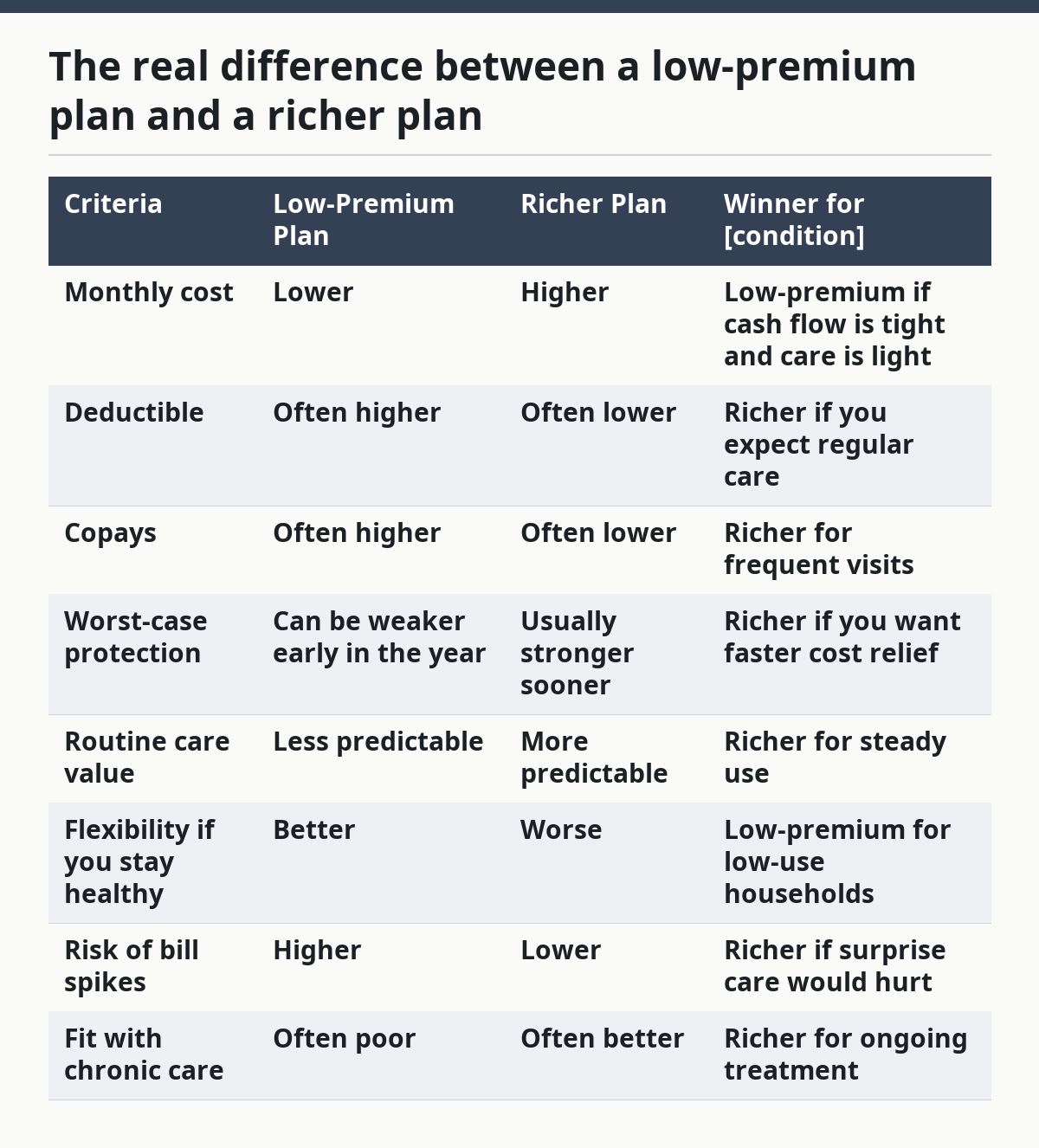
On the flip side, low premium does not automatically mean bad value. If you barely use care, paying extra every month for lower copays can be wasted money. That is why the real winner depends on use, not adjectives.
What network fit tells you that premiums hide
Network fit tells you whether the plan is usable where you already get care. A plan can have a great premium and still be a poor choice if your doctor, hospital, or pharmacy is outside the network.
Picture this: you like the monthly price, but your preferred specialist is out of network. Or your local hospital is in network, but the anesthesiologist group is not. That is not a small detail — it can turn one visit into a much larger bill.
The strongest network fit comes from checking more than a directory search. Confirm the actual practice name, the hospital affiliation, and the exact location. Network status can differ by facility or by provider group, so a single broad search is not enough.
Use this order:
- Check your primary care doctor first.
- Then check specialists you already see.
- Then check the hospital you would use in an emergency.
- Then check labs, imaging centers, and pharmacies.
Therefore, if you already know your care pattern, start with the places you actually use. A weak network fit matters most if you have a chronic condition, a planned procedure, or a child who sees multiple providers. It also matters if you travel and need care away from home, because narrow networks can be hard to work around.
The truth is, a plan’s network can be the difference between smooth use and constant billing headaches. If the network is wrong, the rest of the plan has to work much harder to make up for it.
How deductibles, copays, and coinsurance change the fit
Deductibles, copays, and coinsurance decide when you pay, how much you pay, and whether the plan feels usable in real life. The premium is only the entry fee; these cost-sharing pieces decide the rest.
Picture this: two plans have similar monthly premiums, but one has a $0 primary care copay and the other makes you pay full cost until the deductible is met. That difference matters far more than a brochure headline suggests.
Here is the clean way to think about each one:
- Deductible: the amount you pay before the plan starts sharing many costs.
- Copay: a fixed fee for a service like a doctor visit or prescription.
- Coinsurance: a percentage of the bill you keep paying after the deductible.
A plan with a high deductible can still fit well if you rarely need care and want lower monthly bills. It can fit badly if you need frequent imaging, specialist visits, or brand-name medications. The same is true in reverse: low copays help a lot when visits pile up, but they may not justify a high premium if you stay healthy.
A useful check is simple:
- Estimate your yearly visits and prescriptions.
- Add the likely copays and coinsurance.
- Compare that total with the premium difference between plans.
As a result, you get a rough cost picture. Not perfect, but useful enough to stop bad decisions.
Which plan details matter most for prescription coverage?
Prescription coverage matters most when your medications are recurring, expensive, or tied to a strict formulary. If a plan does not cover your drug well, the plan may look fine until refill time.
Picture this: your medication is on one plan’s preferred tier and on another plan’s nonpreferred tier. Or one plan requires prior authorization and the other does not. The difference is not abstract — it can change both access and monthly cost.
Check these four things:
- Formulary status: Is your drug covered at all?
- Tier placement: Is it generic, preferred brand, or nonpreferred brand?
- Restrictions: Is prior authorization, step therapy, or quantity limit attached?
- Pharmacy rules: Can you use your usual pharmacy, or must you use a preferred one?
If you take one low-cost generic drug occasionally, prescription fit may be a minor issue. If you take several chronic medications, it becomes a major part of plan selection. Plans can look similar until one drug lands on a bad tier or gets excluded.
A common mistake is checking only the drug name and not the rule attached to it. Another is assuming any in-network pharmacy will give the same price. That is not how many plans work.
The honest standard is this: if a plan does not cover your current prescriptions cleanly, treat that as a serious mismatch, not a small flaw. If you are unsure how the drug rules affect you, consult a pharmacist, prescriber, or licensed benefits professional, and verify the plan details with the insurer or HealthCare.gov’s drug coverage information: https://www.healthcare.gov/coverage/prescription-drugs/.
The honest side-by-side
The better plan is the one that matches your care pattern, but the decision gets clearer when you compare the parts that actually change your bills. This is where many people make a wrong call by focusing on one number only.
Picture this: you have one plan with lower premiums and another with stronger day-to-day coverage. You need a side-by-side view that does not hide the trade-offs behind marketing language.
| Criteria | Plan with lower premium | Plan with stronger coverage | Winner for [condition] |
|---|---|---|---|
| Monthly payment | Lower | Higher | Lower-premium if cash flow matters most |
| Routine visits | Less protected | More protected | Stronger coverage for frequent visits |
| Specialist care | Can cost more | Often easier to use | Stronger coverage for ongoing specialist care |
| Prescription fit | May be narrower | Often broader | Stronger coverage for multiple meds |
| Surprise care | More bill risk | Less bill risk | Stronger coverage if care is unpredictable |
| Network breadth | Sometimes narrower | Sometimes broader | Depends on your doctors |
| Referral rules | Can be stricter | Can be lighter | Stronger coverage if you want simpler access |
| Best use case | Healthy, low-use member | Regular user of care | Match to actual usage |
The best way to read this table is not “which plan is better?” It is “which plan gives me the fewest surprises for the care I already know I use?” That is the real test.
What if your situation is unusual?
Some situations flip the usual advice, and those are the ones that deserve extra care. A standard comparison can miss them because they live in the exceptions, not the averages.
Picture this: your needs change fast, or the plan has a feature that seems small but matters a lot to you. That’s where a general rule can break.
Exception scenarios:
- You expect one major procedure this year. A richer plan may beat a cheap premium because the deductible and coinsurance can dominate the total cost.
- Your doctor is out of network everywhere. Even a strong plan may be a bad fit if you are attached to that provider and cannot switch.
- Your drugs have hard restrictions. A plan with the right formulary can beat a plan with better visit pricing.
- You need predictable monthly spending. A higher premium may be worth it if it removes big swings later.
These cases matter because they change the shape of the decision. The obvious winner on paper may not survive the real-life use case.
The best move is to identify the one factor that would make the plan fail for you. If that factor is network, drug coverage, or a known procedure, start there and ignore the rest until it passes.
The verdict: which one to choose and why
Choose the lower-premium plan if you use little care, can handle a higher deductible, and your doctors and prescriptions still fit the network and formulary. Choose the richer plan if you expect regular visits, ongoing prescriptions, or a year with known care needs. Neither if your main doctor is out of network or your key medication is poorly covered.
That is the clean call.
Picture this: you are comparing two plans and trying to guess which one will age better over the year. The answer is simple — the winner is the one that matches the care you already know about, not the plan that looks best in a vacuum.
Plan selection mistakes that keep coverage from fitting
The most common mistake is shopping only by premium, then discovering the plan works poorly for the care you actually use. A close second is trusting a directory without checking whether the specific doctor, site, and prescription are covered.
Picture this: you enroll, then find out the specialist needs a referral, the lab is out of network, or the drug is on a bad tier. That is how a plan that looked fine turns into a costly nuisance.
Watch for these traps:
- Ignoring the out-of-pocket maximum.
- Skipping the prescription formulary check.
- Assuming all providers in the same clinic are in network.
- Forgetting to check referrals or prior authorization.
- Choosing a plan that fits last year, not this year.
This is where a careful reader wins. A plan should fit the year you are about to live, not the year you hope you have.
If you want a second official reference point, the Centers for Medicare & Medicaid Services explains coverage and cost-sharing concepts in plain language:
- https://www.cms.gov/medicare/health-drug-plans/health-plans/your-coverage-rights
FAQ
How do I compare two plans if the premiums are very different?
Start by estimating what you would spend in a normal year, not just the monthly bill. Add premiums, likely copays, deductible exposure, and prescription costs, then compare the totals. A lower premium can still cost more overall if you use care often.
Is the lowest premium ever the right choice?
Yes, if you use very little care and can absorb bigger bills when you do need help. The low-premium choice is usually strongest for healthy people with stable, low-use patterns. It is weakest when regular care or expensive prescriptions are part of your life.
What matters more, the network or the deductible?
The network usually comes first because a low deductible does not help if your doctor is out of network. After the network passes, the deductible matters a lot for how expensive the rest of the year will feel. Both matter, but they solve different problems.
How do I tell if prescription coverage fits?
Check whether each drug is on the formulary, which tier it sits in, and whether it has prior authorization or step therapy. If a medication is central to your care, a poor drug fit can outweigh a better premium. That is a common reason people regret a plan choice.
Should I choose a richer plan if I have ongoing treatment?
Usually yes, if your treatment is regular and the plan’s network covers your providers. A richer plan often makes ongoing care more predictable and less expensive at the point of use. If the provider or drug fit is poor, though, even a better benefit design will not fix it.
Drafted with AI; not yet reviewed by a person.