
Last updated: November 19, 2026
Key Takeaways
- Many freelancers can qualify for ACA help, and projected household income usually matters more than self-employment status.
- ACA help for freelancers usually means premium tax credits, and sometimes cost-sharing reductions with a Silver plan.
- For ACA purposes, household MAGI matters, not top-line freelance revenue.
- Estimate annual household MAGI carefully, and keep a buffer if freelance income varies.
If you freelance, the ACA can be the difference between paying full sticker price for coverage and getting monthly help that makes insurance realistic. This guide to ACA and subsidies for freelancers answers the main question: your eligibility usually comes down to your household income, family size, and where that income lands relative to the federal poverty level.
I write about individual health coverage and ACA enrollment rules for self-employed people, so I know where the traps are: irregular income, deductions that change the subsidy math, and the year-end tax reconciliation that can surprise freelancers who guessed too high or too low. For official guidance, see HealthCare.gov and the IRS instructions for Form 8962.
The ACA subsidy question freelancers actually need answered

Yes, many freelancers can get ACA subsidies, and the amount often depends more on projected household income than on the fact that you are self-employed. The practical question is not “Can a freelancer qualify?” It is “What income counts, how do I estimate it without overpaying, and what happens if the estimate is wrong?”
That matters because the ACA marketplace uses your expected annual household income, not your business revenue alone, to decide premium tax credits. For a freelancer, that means gross client payments are not the number that matters. Net self-employment income after allowable business deductions is usually what feeds the subsidy calculation, along with other household income such as a spouse’s wages or investment income. The IRS explains the premium tax credit rules in Publication 974 and the marketplace rules are tied to the tax return you file later, not just the application you submit today. The Centers for Medicare & Medicaid Services and HealthCare.gov both treat this as a projected-income system, which is why freelancers need to revisit estimates during the year.
The catch is that a freelancer can be eligible one month and ineligible the next if projected annual income changes enough. That is not a flaw in the system; it is how the ACA is built. If income is hard to predict, subsidies still work, but only if you update the marketplace when a major change happens.
How ACA subsidies work for self-employed people
ACA subsidies for freelancers usually mean premium tax credits, and sometimes cost-sharing reductions if you buy a Silver plan and your income falls in the eligible range. The premium tax credit lowers your monthly premium. Cost-sharing reductions lower deductibles, copays, and out-of-pocket exposure, but only on eligible Silver plans bought through the marketplace.
The income test is the centerpiece. For most subsidy eligibility, the marketplace looks at modified adjusted gross income, or MAGI, for the household. That includes taxable income items the IRS counts under ACA rules, not just what you deposit from clients. For many freelancers, the biggest lever is the business deduction side: office expenses, software, mileage when deductible, health insurance deductions handled on the tax return, retirement contributions, and other legitimate business costs can reduce net income. The size of your family matters too, because the subsidy comparison uses a percentage of the federal poverty level for your household size.
There is one rule freelancers often miss: you do not need to be “poor” to qualify for help. The subsidy structure is designed around the cost of marketplace premiums relative to income, and the American Rescue Plan changes and later extensions made credits available farther up the income scale than many people expect. But the exact eligibility and amount change with federal law, so a current-year marketplace estimate matters more than old blog posts.
The downside is that if you estimate too low and your final income is higher, the IRS may reduce or claw back part of the credit when you reconcile on Form 8962. If you estimate too high, you may pay more than necessary all year and only get the extra back later as a tax refund or credit reconciliation. For freelancers with uneven income, the subsidy is useful but not hands-off.
What income counts when you’re freelance?

For ACA purposes, the number that matters is household MAGI, not your top-line freelance revenue. That is the sentence most generic guides get wrong, and it causes bad estimates. A freelancer who invoices $80,000 is not automatically treated as earning $80,000 for subsidy purposes if legitimate business deductions bring net profit down; if the numbers are close, consult a tax professional.
MAGI for ACA subsidy calculations starts with adjusted gross income and adds back certain items, which is why the exact tax picture matters. Freelance income generally flows from Schedule C into your return, and the net profit after deductible business expenses is what usually matters most. If you have a spouse, their wages count too. If you have unemployment compensation, taxable Social Security, taxable interest, dividends, or capital gains, those can also count. The marketplace is not trying to guess your bank balance; it is trying to estimate the income that will show up on your tax return.
The practical mistake freelancers make is using cash flow instead of taxable income. That can go either way. A freelancer can be cash-rich but subsidy-eligible if business deductions are heavy. Or a freelancer can have a modest business income but still lose some subsidy because a spouse’s W-2 pushes household MAGI higher than expected.
If income changes midyear, update the marketplace. Do not wait until open enrollment. A raise, a big contract, a spouse starting work, or a strong fourth quarter can move your subsidy enough to matter. The official marketplace guidance from HealthCare.gov and the IRS makes clear that you are supposed to report changes, not let them sit until tax time.
How to estimate subsidy eligibility without guessing wrong
Use projected annual household MAGI, then build in a buffer if your freelance income swings. That approach is usually safer than aiming for the lowest possible estimate. I would not recommend relying on a single average month if your client pipeline is lumpy or seasonal.
Start with the year you expect, not the year you wish for. Add reliable wage income from any spouse. Add expected net self-employment profit, not gross receipts. Then include income items you might forget: interest, dividends, rental profit, taxable retirement distributions, and unemployment if relevant. If your business has large deductible expenses early in the year, remember that a deduction now can make you more subsidy-eligible, but only if it is legitimate and actually deductible. The IRS rules are tax rules, not rough guesses.
A useful mental model is this: if your projected annual income is close to a subsidy threshold, the marketplace estimate is fragile. A freelancer earning near a cutoff should assume the credit may change during the year and should revisit the estimate after major income swings. HealthCare.gov’s estimator can help, but it is only as accurate as the inputs.
Here is the real trade-off. A lower income estimate can mean a larger monthly credit and a lower premium today. A higher estimate can mean less monthly help now, but less chance of repaying credits later. Neither is “right” in the abstract. The better choice depends on how predictable your freelance income actually is. If income is volatile, a conservative estimate plus regular updates is safer than trying to maximize the monthly credit.
Are ACA subsidies worth it for freelancers?
Yes, ACA subsidies are usually worth pursuing if your household income lands in range, because they can turn an expensive individual policy into something usable month to month. For a freelancer buying coverage alone, the difference between unsubsidized and subsidized premiums can be the difference between enrolling and going uninsured.
That said, subsidies are not always the best fit. If your income is too high for meaningful credit, you may still find marketplace coverage worth buying for network access and guaranteed issue protections, but the subsidy itself will not do much. If your income is very low and your state did not expand Medicaid, the ACA subsidy system can become complicated because eligibility rules differ depending on where you live. In expansion states, Medicaid may be the better answer below a certain income level. In non-expansion states, some low-income adults fall into a coverage gap. That is one of the ugliest corners of the system, and it is a real reason the answer is not the same everywhere.
The upside of the ACA for freelancers is predictable. You do not need employer sponsorship. You can buy coverage on the marketplace, and if your income qualifies, the tax credit lowers the cost. You also cannot be denied because of preexisting conditions. That matters for self-employed people who may not have the luxury of waiting for perfect health.
The downside is paperwork and uncertainty. You must project income, compare plans, and reconcile later on your tax return. If you hate administrative follow-through, the subsidy can still be valuable, but it will not be effortless. A freelancer who wants zero paperwork and has a strong alternative like a spouse’s employer plan may be better off there, even if the marketplace credit looks attractive on paper.
The honest head-to-head: subsidy help vs going without marketplace help
Choosing a subsidized ACA plan beats going uninsured for almost every freelancer who can qualify. It also beats buying a marketplace plan without checking whether the tax credit applies. The main comparison is not “subsidy or no subsidy” in the abstract; it is whether the marketplace plan becomes affordable enough to hold through a full year.
| Criteria | ACA plan with subsidies | ACA plan without subsidies | Winner for condition |
|---|---|---|---|
| Monthly premium | Often reduced by premium tax credit | Full sticker price | Subsidy winner if income qualifies |
| Deductible and copays | May improve with Silver and cost-sharing reductions | No subsidy-based reduction | Subsidy winner if CSR-eligible |
| Tax filing complexity | Requires Form 8962 reconciliation | Simpler return | No-subsidy winner if income is stable and credit is tiny |
| Income volatility | Must be updated during the year | Less exposure to subsidy repayment issues | No-subsidy winner if income swings wildly above threshold |
| Eligibility sensitivity | Depends on projected MAGI and household size | Not dependent on subsidy math | No-subsidy winner if estimate is uncertain and credit is minimal |
| Protection against medical denial | Guaranteed issue still applies | Guaranteed issue still applies | Tie |
| Long-term affordability | Usually better for middle and lower incomes | Harder to sustain | Subsidy winner if marketplace premium is otherwise burdensome |
| Plan choice | Marketplace menu plus subsidy effect | Same plan menu, full cost | Tie |
| Risk of later repayment | Present if income ends up higher than projected | None from subsidy reconciliation | No-subsidy winner if repayment risk matters more than monthly savings |
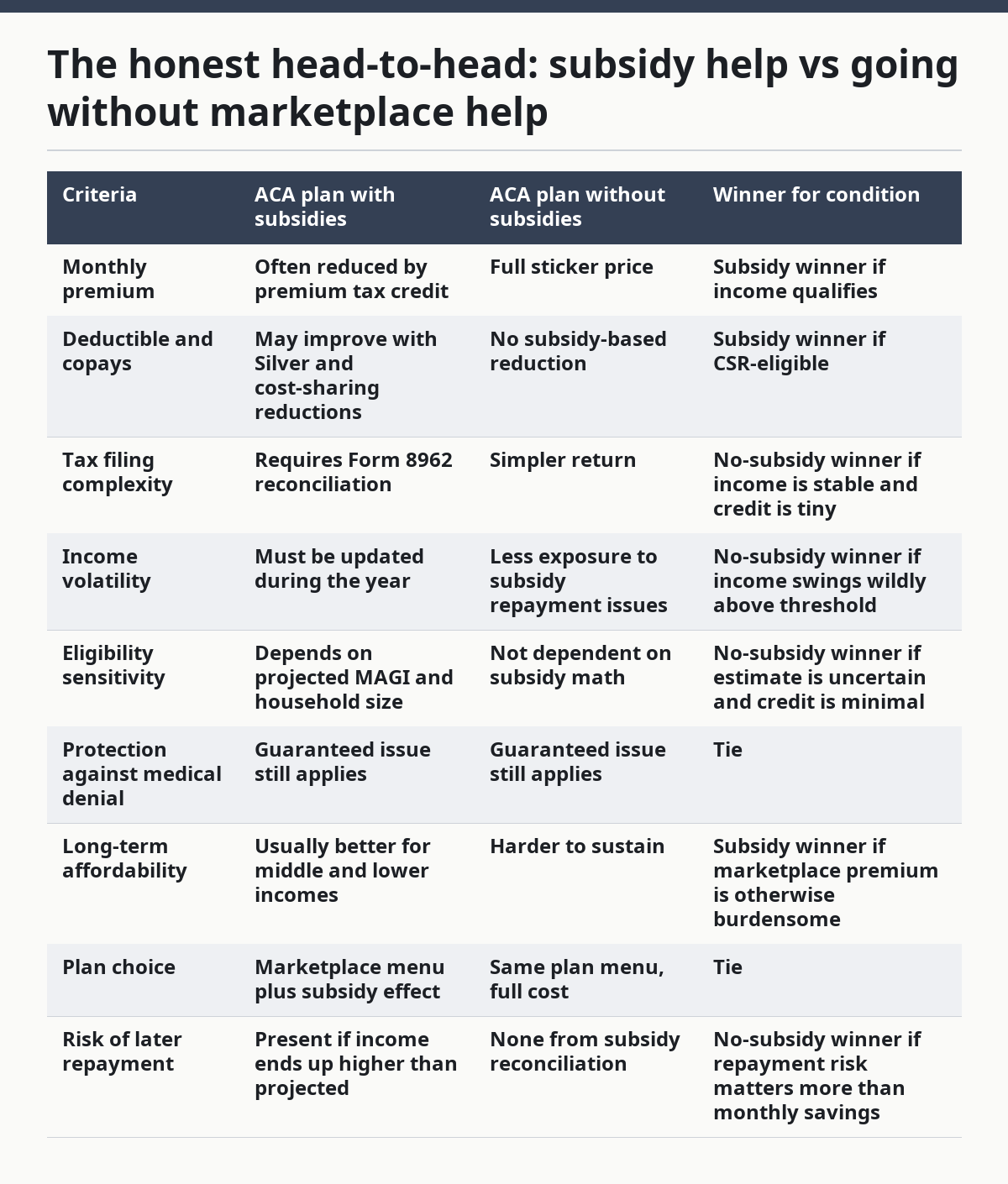
The real decision is simple: if the subsidy meaningfully lowers the premium, take it and keep your income estimate current. If the credit is small and your income is likely to jump, the administrative hassle may not be worth the monthly reduction. I would not tell a freelancer to ignore a subsidy just because tax reconciliation exists. That would miss the point of the ACA. But I would also not pretend every credit is worth chasing if your income is near a cliff and likely to spike.
When the usual ACA subsidy advice flips
The usual advice flips in four situations, and this is where many generic guides fail.
First, if you qualify for Medicaid in your state, that may beat a subsidized marketplace plan on out-of-pocket cost. Medicaid eligibility rules are state-specific, and in expansion states the income floor can make Medicaid the better first stop for very low-income freelancers. A marketplace subsidy is not automatically the better deal.
Second, if you have access to an affordable employer plan through a spouse or another job, the marketplace subsidy may disappear or become irrelevant. ACA eligibility rules can be blocked by employer coverage that is considered affordable under federal standards. That is a needed detail freelancers often overlook because the freelance income is not the whole household picture.
Third, if your freelance income is highly erratic and likely to overshoot your estimate, a subsidy can still help, but only if you are disciplined about updates. If you know you will have a large year-end contract, a big sale, or a step-up in revenue, it may be wiser to estimate higher than to chase the largest possible monthly credit and face repayment later.
Fourth, if you are eligible for ACA coverage but your plan choice is between a cheap Bronze plan and a better Silver plan with cost-sharing reductions, the subsidy decision is not just about premium. A Silver plan can be the smarter move when medical use is likely, because the lower deductible and lower copays may save more than the premium difference over a year. That is especially true for freelancers who want predictable cash flow rather than a low monthly bill paired with a large deductible.
Which freelancers should use subsidies, and who should skip them?
Freelancers should use ACA subsidies if their projected household MAGI falls in the eligible range, their income is reasonably estimable, and the monthly premium reduction is large enough to matter. That is the core use case. A solo consultant, designer, writer, contractor, or gig worker with uneven but trackable income is the classic candidate.
Skip subsidy chasing if your household income is clearly too high for meaningful help, if your income is about to change in a way you already know will break the estimate, or if you have better coverage through a spouse or another source. In those cases, the marketplace may still be useful, but the subsidy hunt is not the main event.
Here is the cleanest recommendation I can give: choose the ACA subsidy path if you need the marketplace to be financially workable and you can keep your income estimate current. Choose a non-subsidized approach only if the credit is negligible or your household situation makes the marketplace estimate unreliable. Neither path is ideal if you are trying to game the system; the reconciliation rules are built to catch that.
What freelancers should do before open enrollment
Before open enrollment, gather your prior year return, your year-to-date freelance net income, and a realistic estimate of the next 12 months. Then run the numbers as a household, not as a solo business. That one step prevents most subsidy mistakes.
You should also check whether a Silver plan with cost-sharing reductions is available to you, because that can be more valuable than a slightly lower premium on a Bronze plan. The marketplace generally compares plans by metal tier, provider network, deductible, and monthly premium, but the subsidy interaction can change the real-world value of each option. For many freelancers, the correct move is to compare the total cost of care, not just the sticker premium.
If your income changed sharply in the current year, report it as soon as possible. Do not assume the marketplace will “average it out” for you. It will not. That is how people end up with a tax bill or a smaller refund than expected.
For authoritative guidance, the IRS instructions for Form 8962 and HealthCare.gov’s subsidy estimator are the two pages I would keep open while you work through the numbers. The IRS pages explain the tax reconciliation side, and HealthCare.gov explains the marketplace side. Both matter. See also IRS Publication 974 and HealthCare.gov’s savings calculator.
The bottom line for freelancers
ACA subsidies are usually worth it for freelancers when household income falls within range and the estimate is close enough to reality to avoid a tax-time surprise. The system is built for people whose earnings do not arrive in neat payroll chunks. That is exactly why it helps freelancers, but it also means the burden of estimating income falls on you.
Choose the subsidy if it meaningfully lowers your monthly premium and you can track your income through the year. Choose a non-subsidized route if the credit is tiny or your income is too unstable to estimate responsibly. Neither if you are ignoring Medicaid, a spouse’s employer coverage, or a known income jump that makes the marketplace estimate unreliable.
The ACA is not perfect for freelancers, but it is one of the few health coverage systems that can adapt to irregular income without shutting the door. That flexibility is the point.
Drafted with AI; not yet reviewed by a person.