How freelancers choose an HSA-compatible ACA plan with a health

Last updated: November 20, 2026
Quick answer: 3 checks decide whether freelancers choose an HSA-compatible ACA plan with a health savings account: the Marketplace plan must be a qualifying high deductible health plan (HDHP), it must keep non-preventive care off the table before the deductible, and it must fit the IRS HSA rules. Check the plan details for the HDHP label, the deductible, and the out-of-pocket maximum, then confirm it is HSA-eligible before you enroll. This is information, not financial advice; a qualified adviser should review your own tax situation. For the federal rules, see IRS Publication 969 and HealthCare.gov’s Marketplace plan guidance: https://www.irs.gov/publications/p969 and https://www.healthcare.gov/choose-a-plan/catastrophic-health-plans/
Key takeaways
- An HSA-compatible ACA plan is not just “a Marketplace plan with an HSA.” It has to meet HDHP rules.
- The plan can cover preventive care before the deductible and still qualify.
- The HSA gives tax advantages, but only if you keep the plan and the account rules aligned.
- The wrong choice is often a plan that looks cheap monthly but breaks HSA eligibility, or a plan that fits care needs but does not qualify for HSA use.
- You should verify plan status, contribution rules, and eligible expenses before you enroll.
Who this is for

However, this applies to freelancers who buy coverage on the ACA Marketplace and want the HSA tax treatment that goes with a qualifying HDHP. It assumes you already know the difference between a monthly premium and a deductible, and that you are shopping for yourself, not through an employer plan. If you are covered by another health plan, including one that pays for more than preventive care before the deductible, the HSA rules may change and you should get qualified help. IRS Publication 969 is the best starting point for that tax question.
The main question is simple: can the Marketplace plan and the HSA work together without breaking the tax rules? The answer is yes, but only if the plan meets the HDHP standard and the HSA is opened and funded correctly. IRS guidance in Publication 969 and Form 8889 is the place to verify the tax side, while HealthCare.gov explains Marketplace plan structure and metal tiers in plain terms.
The point is not to chase the lowest monthly bill. A freelancer who expects regular prescriptions, specialist visits, or a lot of non-preventive care may find that the HSA angle does not offset the plan design. In that case, the plan may still be a good Marketplace option, but not a good HSA-compatible one.
How do I tell if a Marketplace plan is HSA-compatible?
Because the plan must fit the HSA rules, start with the plan details, not the premium. A Marketplace plan is HSA-compatible if it is a qualifying HDHP and its benefits fit the HSA rules. The fastest practical check is to look for language in the plan details that says HSA-eligible, HSA-compatible, or qualifying HDHP, then verify the deductible and out-of-pocket maximum against the plan’s summary of benefits.
Use this order:
- Open the plan’s summary of benefits and coverage. Look for the words “HSA-eligible” or “HSA-compatible.”
- Confirm that the plan uses a deductible-based structure, not broad first-dollar coverage for non-preventive care.
- Check that preventive care is still covered before the deductible. That is normal and does not break HSA status.
- Look at the out-of-pocket maximum. The plan must still fit the HDHP framework, not just feel high deductible.
- Verify that no extra benefits are built in before the deductible for services outside preventive care.
- Check whether the plan covers telehealth, urgent care, or prescriptions in a way that still preserves HSA eligibility.
- Confirm that you do not have another plan or benefit that disqualifies HSA use.
- Read the HSA eligibility note on the Marketplace page before you enroll.
A problem usually shows up in one of two ways: the plan never says it is HSA-compatible, or it covers too much too early. A common mistake is assuming that every bronze plan qualifies. Some do, some do not. The label matters more than the metal tier.
If the label is missing, that is a reason to pause and confirm the plan with the Marketplace, the insurer, or a qualified adviser before you enroll. IRS Publication 969 is the tax reference for the eligibility side: https://www.irs.gov/publications/p969
Which plan features matter most?

Therefore, the deductible, preventive care coverage, and HSA eligibility note matter more than the metal tier by itself. The metal tier tells you how the plan generally shares costs, but it does not by itself prove HSA compatibility.
| Plan feature | What it tells you | What to check | What to skip |
|---|---|---|---|
| HSA-eligible / HSA-compatible label | The plan is designed to work with an HSA | Read the plan page and benefits summary | Any plan that never states HSA eligibility |
| Deductible | How much you pay before most non-preventive care is covered | Confirm the deductible is listed clearly | Plans with vague or missing deductible details |
| Preventive care | Routine care can be covered before the deductible | Verify the plan keeps preventive care separate from other services | Plans that bundle non-preventive visits into first-dollar coverage |
| Out-of-pocket maximum | The most you may pay for covered services in a year, under plan rules | Check that the number is shown in the plan summary | Plans that hide cost-sharing details |
| HSA rules | Whether you can contribute and use the account tax-advantaged | Match the plan to IRS HDHP guidance | Assuming an HSA works with any ACA plan |
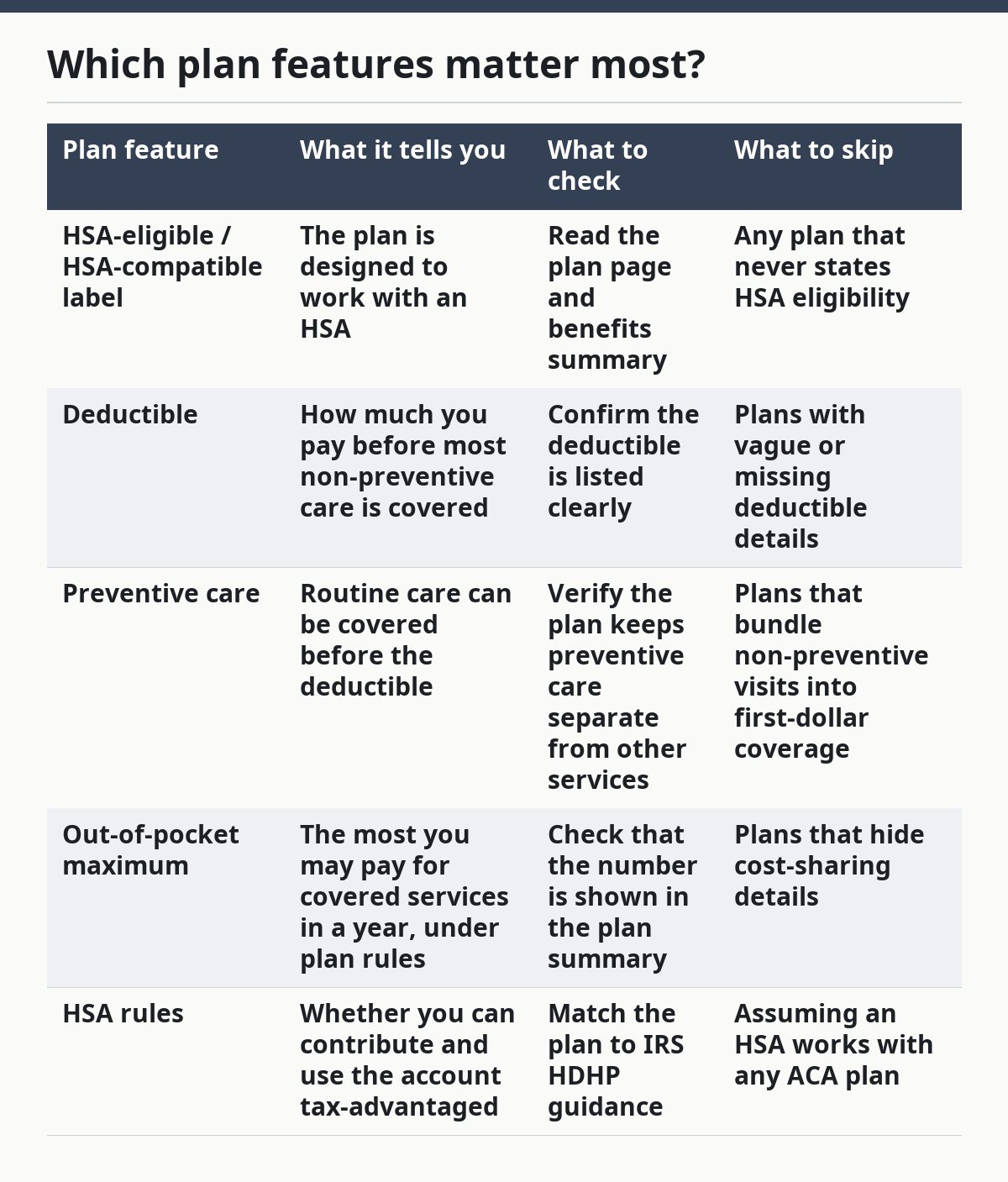
A good fit is usually a plan that clearly marks itself as HSA-eligible and keeps benefits simple enough to read in one pass. A poor fit is a plan that looks attractive because of a low monthly premium but is not HSA-compatible, or one that adds too many early benefits outside preventive care.
How do I choose one step by step?
Next, choose it by checking the plan first, then the account, then the tax fit. Do not start with the monthly bill alone; that is how freelancers end up with a plan that looks cheap but does not match the HSA rules.
- Open the Marketplace plan summary and find the HSA label. Verify it says HSA-eligible, HSA-compatible, or qualifying HDHP. If the label is missing, treat that as a warning sign and confirm it with the insurer or a qualified adviser.
- Check the deductible and out-of-pocket maximum on the same page. Verify the numbers are clearly listed and that the plan is built around paying more up front before most non-preventive care is covered. If those figures are unclear, stop and compare another plan.
- Read the section on preventive care. Verify that preventive services can be covered before the deductible, since that is normal for HSA-compatible coverage. If the plan pays broadly for non-preventive care before the deductible, it may fail the HSA test.
- Review prescription and visit rules. Verify how the plan treats drugs, specialist visits, and urgent care, because some plans handle these before the deductible in ways that affect HSA status. If the plan’s summary is vague, use a different plan or ask for clarification.
- Confirm you do not have disqualifying coverage elsewhere. Verify that you are not also enrolled in another plan that pays for more than preventive care before the deductible. If you are, the HSA can be a problem.
- Check the HSA contribution rules for the year. Verify the limit with the IRS for the tax year you are using, since limits change. If you do not know the current limit, do not guess; look it up before funding the account.
- Look at eligible expenses. Verify that you are comfortable using HSA money for qualified medical expenses such as doctor visits, prescriptions, and other IRS-qualified costs. If you want the account for general spending, that is not what it is for.
- Save the plan documents. Verify you have the Summary of Benefits and Coverage, the Marketplace page, and your HSA paperwork in one place. If you cannot find the rule later, that is a sign you did not capture the right documents.
The result you want is a plan that clearly qualifies, a deductible you can understand, and an HSA you can keep aligned with the plan year. If you have to decode the policy language for 20 minutes, the plan is probably not the right one to move forward with.
What should I compare before I enroll?
So compare the plan’s HSA status, deductible, preventive care rules, and how the account will be used. If you compare only premiums, you can miss the part that determines whether the HSA is allowed at all.
A useful comparison is between a plan that is clearly HSA-compatible and a plan that is not, even if both are on the Marketplace.
| Question | HSA-compatible ACA plan | ACA plan that is not HSA-compatible |
|---|---|---|
| Can you open and fund an HSA with it? | Yes, if all HDHP rules are met | No, or not safely |
| Is preventive care still covered? | Yes | Usually yes |
| Does the plan rely on a deductible-based structure? | Yes | Not always |
| Can non-preventive services be covered before the deductible? | Limited, if at all | More likely |
| Who it fits | Freelancer who wants the HSA tax structure and can handle higher upfront costs | Freelancer who wants broader first-dollar coverage and does not need the HSA |
The wrong choice here is treating the HSA as a side perk. The HSA is tied to the plan design, not just added on later. If the plan does not qualify, the account may not work the way you expect, and tax reporting can get messy.
When should I stop and get help?
However, stop and get qualified help if the tax or coverage situation is not clean. That is especially true because HSA rules interact with other coverage, tax filing, and year-by-year limits.
You have another health plan that pays for non-preventive care before the deductible: that can break HSA eligibility — do not assume you can still contribute; confirm the rule with a tax professional or benefits adviser.
You are covered by a spouse’s plan or another family plan with broad first-dollar benefits: the coordination can affect your HSA status — check before you enroll or contribute.
You are unsure whether the plan is truly HSA-compatible: the Marketplace label may not be enough on its own — verify the Summary of Benefits and ask for written confirmation if needed.
You already contributed to an HSA but later learn the plan was not eligible: the tax treatment may need correction — speak with a qualified tax adviser as soon as possible.
You need regular non-preventive care and the plan language is hard to interpret: the plan may not be the right fit even if it qualifies on paper — compare again with a different Marketplace option.
Your income, filing status, or family situation is changing during the year: HSA and Marketplace tax rules can shift with your circumstances — review both before you make a final choice.
IRS Publication 969 and the instructions for Form 8889 are the right documents to review when the rule gets technical: https://www.irs.gov/forms-pubs/about-form-8889
What mistakes do freelancers make?
Therefore, the biggest mistakes are choosing a plan by premium alone, assuming every bronze plan is HSA-compatible, and funding the HSA before checking eligibility. Those errors can lead to a plan that does not fit the tax rules or a tax filing problem later.
- Picking the cheapest monthly premium without reading the HSA label. The consequence is a plan that may not qualify. The better alternative is to confirm HSA compatibility first, then compare cost structure.
- Assuming preventive care coverage means the whole plan is HSA-eligible. The consequence is a false match between the plan and the account. The better alternative is to check the HDHP status, not just the preventive benefit.
- Ignoring other coverage. The consequence is disqualification through another plan that pays too much too early. The better alternative is to review all active coverage before opening the HSA.
- Not checking the current contribution rules. The consequence is funding the account under the wrong assumptions for that tax year. The better alternative is to verify the year’s IRS rule before contributing.
- Treating HSA money like free cash. The consequence is a tax problem if the expense is not eligible. The better alternative is to keep receipts and use the account for qualified medical expenses only.
- Skipping the plan documents after enrollment. The consequence is not being able to prove eligibility later. The better alternative is to save the Marketplace summary and HSA paperwork together.
The thread through all of these is simple: the HSA works only when the plan, the account, and the tax rule all line up. If one piece is off, the whole arrangement can fall apart.
What changes the standard approach?
Because of that, the standard approach changes when your coverage is mixed, your family situation is complex, or your care use is unusually heavy. In those cases, the usual “pick an HSA-compatible Marketplace plan and fund the HSA” path needs more checking.
If you have dual coverage, the HSA decision gets harder because one plan can disqualify another. If you are adding or losing a spouse’s plan during the year, the HSA rules may change midstream. If you expect frequent specialist care, a high deductible may make the plan feel worse even if it qualifies on paper.
One practical edge case is a plan that is technically HSA-compatible but still a poor fit for your spending pattern. That does not mean it is wrong in the tax sense; it means the tax benefit may not outweigh the way the plan shares costs. Another edge case is a freelancer who wants the HSA mainly for saving, not for spending. That can work, but only if the plan itself qualifies and the account stays in good standing under IRS rules.
For plain-English plan shopping, the best place to compare your broader Marketplace options is the self-employed coverage shopping and plan selection hub. If you want more background on Marketplace plan types, use the coverage pages at HealthCare.gov. This page only answers the HSA-compatibility piece, not the full deductible-versus-copay decision.
Drafted with AI; not yet reviewed by a person.