
How freelancers handle health coverage for a disabled dependent adult

Last updated: November 21, 2026
Quick Answer: In most cases, a freelancer can keep health coverage for a disabled dependent adult only if the person meets the plan’s rules; the process usually comes down to 3 things: the plan language, the proof on file, and ongoing recertification. This is information, not financial advice; for your own case, a qualified adviser should check the plan rules and any state or federal rule that applies.
This article on how freelancers handle health coverage for a disabled dependent adult explains the plan rules, the documents, and the renewal steps that usually matter most. A qualified benefits adviser should review the plan if the dependent’s status, residence, or legal authority is unclear.
Who this applies to
This applies to a freelancer who is trying to cover an adult child or other adult dependent with a disability under a health insurance plan and already has a plan in place, or is trying to keep one in force. It assumes the reader knows the dependent’s age, the plan type, and whether the dependent has proof of disability on hand.
It does not assume the answer is the same for every plan. A group plan, an individual health insurance plan, and a public program can use different rules, and those rules can change by country, state, and plan year. If the dependent’s status is disputed, or if a doctor’s note, tax record, or disability finding is missing, this is not a “figure it out later” situation; it is a case for qualified help because the wrong filing or missed deadline can break coverage.
The right place to start is the plan document, the dependent eligibility rule, and the paperwork list. The clearest federal reference in the United States is usually the HealthCare.gov page on people with disabilities, but even that does not replace the actual plan contract. For benefits questions tied to disability findings, the Social Security Administration’s disabled adult child information can also matter.
What counts as a disabled dependent adult?

A disabled dependent adult is an adult whom the plan treats as eligible because of a disability rule, not just because of age or family relationship. In many plans, that means the person does not age out in the ordinary way if the disability is documented and the plan’s definition is met; for a specific case, a qualified benefits adviser should check the current plan language and any controlling rule.
The key word is dependent eligibility: the set of rules that says who can stay on the policy and under what proof. A plan may require that the disability began before a certain age, that the adult is unable to support themself, or that the person remains financially dependent in a specific way. Those details are not universal, and the exact standard can differ between health insurance plans.
This is where many people go wrong. They assume a disability diagnosis alone is enough. It often is not. What matters is how the plan defines the condition, who signs off on it, and whether the dependent still fits the rule at the next review date.
How do you handle the coverage step by step?
The process starts with the plan rule, then moves to proof, then to reporting, and then to keeping the record current. A freelancer should treat this like an eligibility file, not a one-time form, and a qualified adviser can help if any step is unclear.
- Read the dependent rule in the plan document. Find the section that says who qualifies as a dependent adult and note any age limit, disability standard, and review period. Verify the exact definition used by the plan; a mismatch here usually means the rest of the paperwork will be rejected.
- Collect the required documentation before filing. Gather the disability proof, identity records, and any financial support records the plan asks for. Verify that the names and dates match across documents; a one-letter mismatch or a wrong date of birth is a common reason a file stalls.
- Check whether the plan wants ongoing proof. Some plans ask for annual or periodic recertification, which means you may need to repeat the same paperwork later. Verify the review interval written in the plan, because missing a recertification date can end coverage even when the disability has not changed.
- Report the dependent the way the plan requires. Use the employer portal, insurer form, or member services process named in the policy. Verify the submission method; a mailed form sent to the wrong office can count as unfiled.
- Save a copy of everything submitted. Keep the form, attachments, confirmation number, and any email reply in one place. Verify that you can show the date and contents of the filing; if the plan questions the file later, memory is not enough.
- Track any change in support, residence, or legal status. If the dependent moves, changes guardianship status, or starts receiving other benefits, check whether the plan says that affects eligibility. Verify whether the change must be reported within a set time, such as 30 days, if the plan uses a reporting window.
- Recheck the rule every plan year. Renewal forms can use a new standard even when the dependent’s condition has not changed. Verify the current year’s language before open enrollment or renewal, because a copied old form can leave a gap.
- Escalate a denial quickly. If the insurer says the dependent no longer qualifies, ask for the reason in writing and the appeal steps. Verify the appeal deadline; once that window closes, the options shrink fast.
The point of the process is simple: show that the dependent fits the rule now, not just once in the past. A clean file usually has the plan language, the disability proof, the renewal record, and the reporting history all lined up in the same folder.
What proof is usually needed?

The proof usually includes documents that show the disability status, the dependent relationship, and the reason the plan should treat the adult as eligible. For a specific file, a qualified adviser should confirm what the plan wants, because that may mean medical records, a physician statement, a disability determination, or tax or guardianship records.
A generic “has a disability” note may not be enough. Plans often want the paper trail to answer three questions: Does the person qualify under the plan’s definition, did the condition exist at the right time, and does it still apply now? If the plan asks for a form signed by a doctor within the last 12 months, an older note may fail even if the facts have not changed.
Keep the file practical. One folder should show the dependent’s identity, one should show the disability basis, and one should show continued eligibility. If the plan requests a document from a court, a school, or a government agency, use the exact version it names and do not substitute a different record unless the insurer says it will accept it.
Which plan rules matter most?
The plan’s own eligibility language matters most, then the state and federal rule that governs that plan type. A freelancer should not assume that one rule for a workplace plan carries over to an individual policy or another public program.
| Plan type | What usually changes | What to verify first |
|---|---|---|
| Employer-based health insurance plan | The dependent rule is often written in the group contract and may require periodic proof | The plan booklet, enrollment rules, and recertification date |
| Individual health insurance plan | Coverage rules can be tied to a separate policy contract and renewal cycle | The insurer’s dependent eligibility language and document list |
| Public program | Eligibility may depend on different disability and income rules | The agency rule that controls the program in your state |
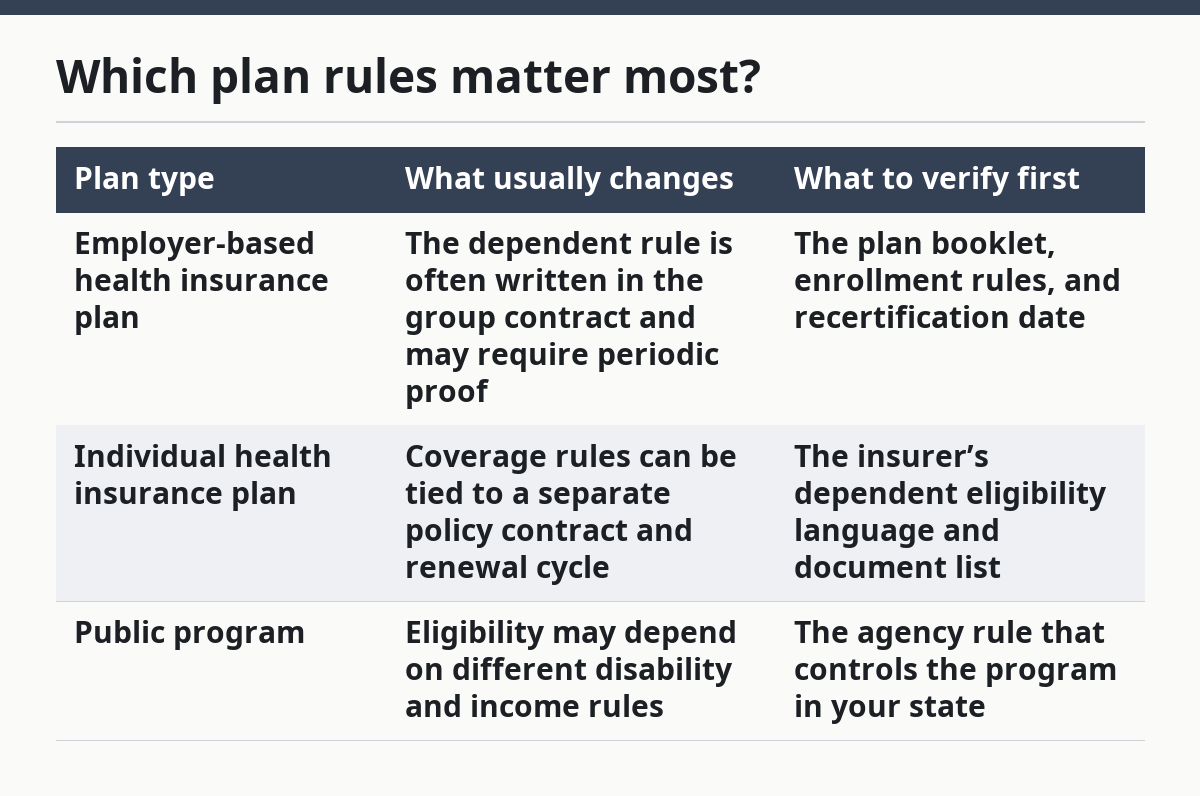
That table is not a shortcut to a decision. It is a warning that the same dependent may be treated differently depending on the plan type, the state, and the renewal cycle. For a freelancer, that matters because income can shift from month to month, and a change in household reporting can affect what the plan asks for next.
The safest habit is to read the current plan language every year and compare it with the last approval letter. If the new language is narrower, do not assume the old approval protects you automatically.
When should you stop and get help?
A freelancer should stop trying to handle this alone when the documentation is incomplete, the plan has denied eligibility, or the household facts are changing faster than the paperwork can keep up. In health coverage, a wrong move can mean a denied claim, a lapse, or a retroactive bill.
No written dependent rule: the plan will not confirm eligibility in writing — ask the insurer or plan administrator for the exact rule before filing anything.
Conflicting records: the medical record, tax record, and plan form do not match — correct the mismatch first, because a small inconsistency can trigger a denial.
Missed recertification date: the plan requires ongoing proof and the date passed — expect a coverage review and act immediately to restore the file.
State or federal rule conflict: the plan language and a government rule point in different directions — get qualified help, because the controlling rule may depend on the plan type.
Appeal deadline is close: the insurer denied the dependent and the deadline is near — file the appeal fast and attach the proof the denial says was missing.
Guardianship or custody changed: a court order or caregiving arrangement changed — ask for legal and benefits guidance, because eligibility can turn on who has authority to act.
The wrong time to improvise is when a deadline or a denial is already on the table. The right move is to freeze the paper trail, get the exact reason in writing, and work from that.
What mistakes cost the most?
The most expensive mistake is assuming the disability itself proves eligibility. It does not if the plan requires a specific date, a specific form, or proof of continued dependence. The cost is often a delayed approval or a claim that gets kicked back.
Another common mistake is using the wrong documentation. A doctor’s letter, a court record, and a government disability decision are not interchangeable unless the plan says they are. If the plan wants a form from the last 12 months and you send a five-year-old note, the file can fail even when the underlying condition has not changed.
A third mistake is missing the reporting duty when household facts change. If support, residence, or legal authority changes, some plans expect notice. Waiting until renewal can create a gap.
A fourth mistake is ignoring the annual review. Many people treat approval as permanent, but recertification can repeat every year or at another set interval. The correct alternative is to keep one calendar reminder for the plan year and one for any proof deadline.
A final mistake is assuming all plans work the same way. They do not. The better approach is to read the current policy language, keep copies of every submission, and ask for the denial reason in writing if the plan rejects the file.
How long does it take?
It often takes as long as the slowest document in the file, not as long as the form itself. If the plan asks for one signed statement, a matching identity record, and proof of disability, the process can move quickly once every piece is in hand; if one record is missing, the wait can stretch until that record arrives.
A good result looks like this: the plan confirms the dependent in writing, the file lists the current eligibility basis, and any recertification date is clear on the calendar. A bad result looks like a silent approval gap, a claim denial, or a notice that says the dependent no longer qualifies but does not explain why.
For freelancers, the hard part is not just gathering papers. It is keeping the coverage file stable while income, household structure, and plan type can all shift in the same year. That is why the same issue belongs on the main [health insurance rules for freelance households] hub and on this page: the dependent rule is its own problem, not a side note.
Key takeaways
- A disabled adult dependent is covered only if the plan’s own rule says the person qualifies.
- Proof matters as much as the diagnosis; the plan may want current, matching documents.
- Ongoing eligibility can end if recertification is missed, even when nothing else changed.
- Reporting changes quickly is part of keeping coverage active, not an extra chore.
- When the plan denies coverage or the papers do not line up, written reasons matter more than guesses.
Can an adult child stay on a plan because of disability?
Yes, sometimes, but only if the plan’s rule allows it and the proof fits that rule. The disability alone is not enough if the plan also requires a specific age of onset, financial dependence, or ongoing documentation.
What proof is needed for dependent status?
The proof usually includes a disability document, identity records, and whatever the plan asks for to show the adult still qualifies as a dependent. Some plans want a physician statement or a government determination; others want a recertification form every year or at another set interval. Use the exact documents the plan names.
Does the rule differ by plan type?
Yes, the rule can differ by plan type, because each plan can use a different contract, process, and review cycle. A group plan, an individual health insurance plan, and a public program may each ask for different proof or use a different deadline. Read the rule for the plan you actually have, not a similar one.
Drafted with AI; not yet reviewed by a person.