
Last updated: November 27, 2026
Quick answer: the 2 plan types behave differently, and PPOs usually handle out-of-network care better for freelancers because they may pay part of the bill outside the network, while HMO plans usually do not except for emergencies or limited exceptions. If you expect to see a specialist, keep a favorite doctor, or work in more than one city, that difference can matter fast. For a plain-language overview of plan types, the federal Marketplace explains the basics here: HealthCare.gov plan categories. For the rules around surprise billing and emergency care, the Centers for Medicare & Medicaid Services has a clear federal explainer.
Key takeaways
- PPOs are usually the better fit if you want any real out-of-network help.
- HMOs usually keep costs tighter, but they are far less flexible when you leave the network.
- Emergency services are the main situation where both plan types may still help outside the network.
- Referrals and prior approval can change the result, especially for exceptions.
- Balance billing can leave you paying the gap between the provider’s charge and what the plan allows.
For a plain-language overview of plan types, the federal Marketplace explains the basics here: HealthCare.gov plan categories. For the rules around surprise billing and emergency care, the Centers for Medicare & Medicaid Services has a clear federal explainer. If you are comparing plan choices, you can also review how to choose a health plan and health insurance for freelancers before you enroll.
What changes when you go out of network?
Out-of-network care means the doctor, clinic, or hospital is not in the plan’s contracted list, so the insurer can apply different rules to the claim. For freelancers, that is the part that can turn a routine visit into a large bill, because the plan may cover less, require more paperwork, or cover nothing at all.
A PPO is built to give some access outside the network. An HMO is built to keep care inside the network except for narrow cases, usually emergencies and a few approved exceptions. That is the core difference, and it matters more than almost any brochure language about “choice.”
The practical issue is not just whether a claim is processed. It is also whether the plan counts the visit toward your deductible, whether you need a referral first, and whether the provider can bill you for the balance. Balance billing is the part many people miss: if the provider’s charge is higher than the plan’s allowed amount, you can be left with the difference.
For freelancers, that can hit harder than it does for salaried workers because income is less predictable. A single out-of-network specialist visit can be manageable. A string of follow-ups, scans, and separate bills can get ugly.
HMO vs PPO out-of-network care: the short version
PPOs win if out-of-network access is part of your real life, not just a backup. HMOs win if you want tighter rules, lower friction inside the network, and you are comfortable treating out-of-network care as an exception rather than a feature. If you are unsure which side fits your care pattern, consult a licensed insurance professional or your plan documents before you enroll.
| Criteria | HMO | PPO | Winner for this condition |
|---|---|---|---|
| Routine out-of-network visits | Usually not covered | May be covered at a lower level | PPO if you need regular outside care |
| Emergency services | May still be covered outside the network | May still be covered outside the network | Neither; both can apply in emergencies |
| Referral requirement | Often required for specialist care | Usually less strict | PPO for simpler access |
| Balance billing risk | Can still happen outside covered exceptions | Can happen, especially outside the network | HMO if you stay in the network |
| Flexibility for travel or multi-city life | Limited | Stronger | PPO |
| Need for prior approval | Often tighter | Can still apply, but usually less restrictive | PPO |
| Chance of claim denial for outside care | Higher | Lower than HMO, but still possible | PPO |
| Best fit for strict cost control | Yes, if you stay in network | Less ideal for strict control | HMO |
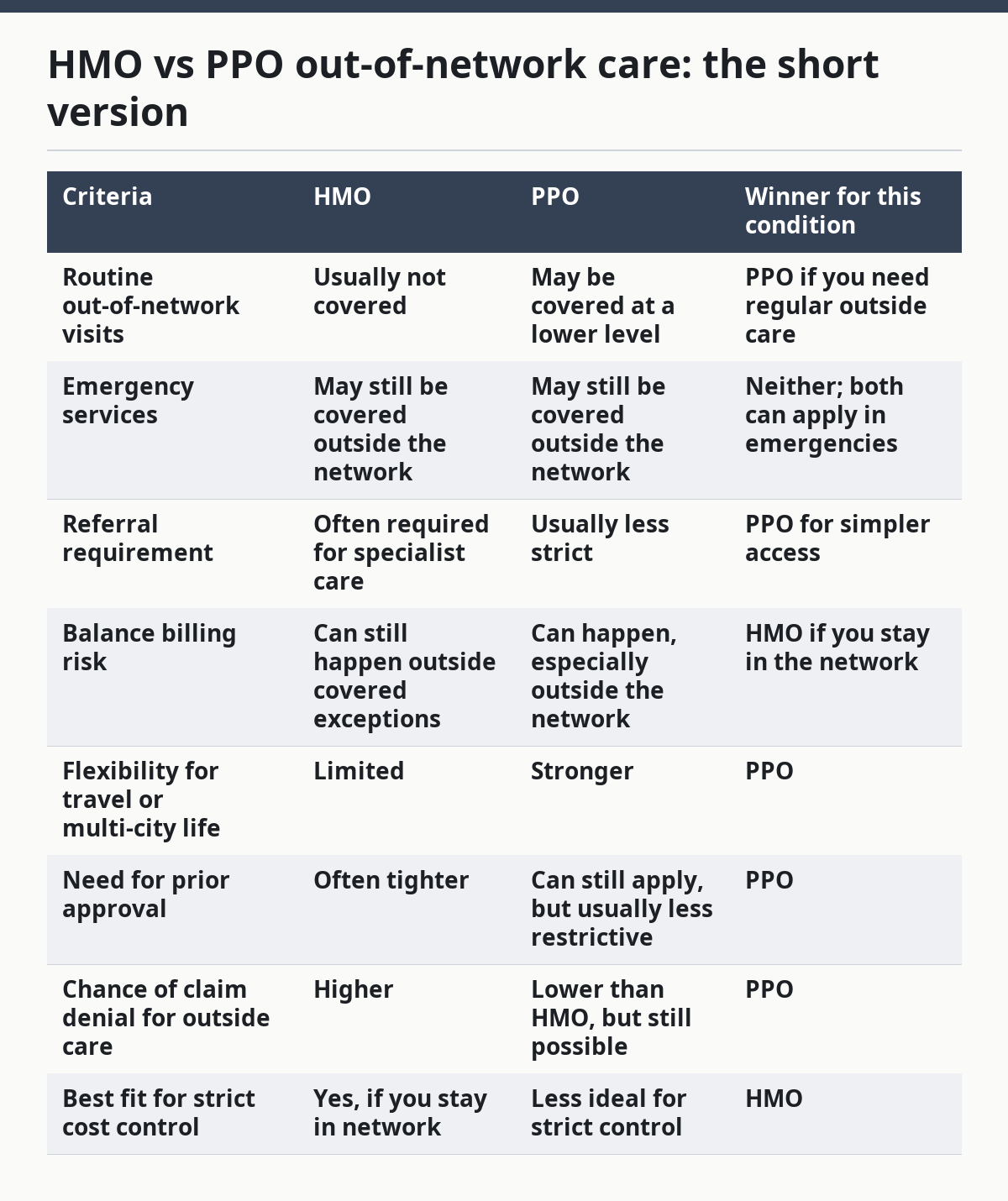
The table is blunt for a reason: the biggest difference is not “better service” or “better doctors.” It is how much the plan will help once you step outside its contracted list.
When does an HMO still help outside the network?
An HMO may still help outside the network in emergencies, but that is the exception, not the rule. It can also help in limited situations where the plan approves care that is not available in its network, though those cases usually need permission first.

That matters because many freelancers hear “HMO” and assume “no out-of-network care ever.” That is not quite right. Emergency services are the clearest example where coverage can still apply, and federal rules also protect many emergency situations from the harshest billing surprises. CMS explains those protections on its No Surprises Act page.
The catch is that an exception is not a free pass. An HMO can still require a referral, prior authorization, or proof that the service was not available in network. If you skip that step, the plan can deny the claim or pay less than you expected.
Here is the real HMO advantage: if you can stay inside the network, the rules are usually simpler and the cost exposure is easier to predict. That is useful for freelancers who want a plan that acts like a gatekeeper. It is not useful for someone who already knows they need a specific doctor outside the network.
HMO pros and cons
Pros
- Usually lower-friction care when you use the network
- Stronger cost control if you follow the plan rules
- Emergency coverage can still apply outside the network
- Clear path for people who want one primary doctor to manage care
Cons
- Routine out-of-network care is usually not covered
- Referrals can slow down specialist access
- Limited flexibility for travel, relocation, or niche specialists
- Not a good fit if you want freedom to self-direct care
An HMO is right for freelancers who can keep their care local, do not mind using the plan’s gatekeeping, and do not expect to shop outside the network often. It is wrong for anyone who already sees an out-of-network specialist or who wants open access without asking permission first.
When does a PPO pay for out-of-network visits?
A PPO may pay for out-of-network visits when the plan allows them, but it usually pays less than it does for in-network care. That trade-off is the whole point of the plan: more choice, more cost risk.
A PPO is the better fit for freelancers who move around, split time between cities, or need a doctor who is not in the plan’s list. It is also better for someone who wants more direct access to specialists, because PPOs are usually less rigid about referrals than HMOs.
The downside is easy to miss. A PPO does not mean “insurance covers everything anywhere.” It may still use a separate deductible, a higher share of the bill, and balance billing exposure if the provider charges more than the plan allows. That is why the plan summary matters more than the label on the card.
If you expect to use outside care only once in a blue moon, a PPO may feel like overkill. If out-of-network care is part of your monthly reality, it may be the safer choice. For many freelancers, that difference is worth more than a small premium gap because it reduces the risk of a claim being denied simply for going outside the plan’s list. For a plan comparison, start with how to choose a health plan and then check the network list line by line.
PPO pros and cons
Pros
- More flexibility for outside doctors and specialists
- Less dependence on referrals for many services
- Better fit for travel, relocation, or split-time living
- More likely to cover some out-of-network care
Cons
- Out-of-network coverage can still leave a large bill
- Balance billing is still a risk
- Costs can be harder to predict than with an HMO
- Some people pay for flexibility they do not use
A PPO is right for freelancers who value choice, may need care in more than one place, or already know that their preferred doctor is outside the network. It is wrong for people who want the lowest-complexity path and who plan to stay inside one local network anyway.
The honest side-by-side
PPOs give freelancers more freedom; HMOs give more control. That is the cleanest way to think about the comparison.

- If you need out-of-network care for a chronic condition, a PPO is usually the more practical choice.
- If you mainly want predictable in-network care and do not want to manage claims disputes, an HMO can make life simpler.
- If you are worried about emergency care only, both plan types can still have protection there, so the decision should not rest on emergency coverage alone.
- If you need a specialist who is not in the plan’s list, an HMO is the wrong tool unless the plan grants an exception.
The part that trips people up is balance billing. It can show up even when a plan pays something, because the insurer and provider do not have a contract. That is why “some coverage” is not the same thing as “safe from big bills.”
Freelancers should also think about referrals as a time cost, not just a paperwork cost. A referral rule can delay care by days or weeks, and that matters when you are the one losing income for every appointment slot you spend chasing approvals.
Which plan should a freelancer choose?
Choose a PPO if you expect to use out-of-network care more than once in a while, if you want fewer referral hurdles, or if your preferred doctor is outside the network. Choose an HMO if you want to stay inside one system, keep rules tight, and treat outside care as the rare exception. Neither is a good fit if you need broad outside access but cannot absorb a possible balance bill.

That is the clear call: PPO for flexibility, HMO for cost control. For freelancers, flexibility usually wins when outside care is likely, because a missed referral or a denied claim can do more damage than the plan’s name suggests.
This is also where the hub article on HMO vs PPO for freelancers should sit beside this page, because the bigger choice is not just about outside care. It is about how much control you want over specialists, paperwork, and where you can seek treatment.
When the verdict flips
Sometimes the usual answer changes, and those exceptions matter.
- If you have a strong local care team in network and no outside specialist needs, an HMO can be the smarter pick even if the PPO sounds more flexible.
- If a specific out-of-network clinician is central to your care, a PPO may still not be enough unless you check how the plan treats that provider. Ask the plan directly before enrolling, and consult a licensed insurance professional if the treatment plan is complex.
- If you travel often or live between cities, a PPO becomes much more valuable because a fixed HMO network can become a real limitation.
- If you only care about emergency protection, the difference between HMO and PPO matters less than the plan’s emergency rules and federal billing protections.
Those are not small edge cases. They are the cases that decide whether the plan feels usable or frustrating after enrollment.
What should you check before enrolling?
You should check the plan’s summary of benefits, the referral rules, and the out-of-network section before you sign up. The label HMO or PPO is too broad to trust on its own.
Look for three things in the plan documents. First, whether out-of-network visits are covered at all. Second, whether they count toward a separate deductible or a different cost share. Third, whether the plan says anything about balance billing or prior authorization.
If a plan is an HMO, ask the direct question: does it cover any out-of-network care beyond emergency services or approved exceptions? If a plan is a PPO, ask a different one: when does it pay for outside visits, and how much of the allowed amount is left for you to cover?
That is the practical test. It is less about the name of the plan and more about what happens when the claim hits the processor.
Does an HMO cover any out-of-network care?
Yes, but usually only in limited situations such as emergencies or approved exceptions. An HMO is designed to keep care inside the network, so routine outside visits are usually not covered the way in-network care is. If the plan says an exception exists, it often comes with referral or authorization rules.
When does a PPO pay for out-of-network visits?
A PPO pays for out-of-network visits when the plan includes outside coverage and the claim fits the plan rules. The payment is usually lower than in-network coverage, and you may still face a separate deductible, a higher share of the bill, or balance billing if the provider charges more than the plan allows.
What counts as out-of-network on these plans?
Out-of-network means the provider is not contracted with the insurer for that plan. A doctor, specialist, hospital, lab, or clinic can all be out of network if the insurer has no agreement with them. That status matters because it changes the allowed amount, the referral rules, and the risk of extra billing.
Drafted with AI; not yet reviewed by a person.